
How to Shorten an Essay Without Losing Meaning
Learn how to shorten an essay without losing meaning, cut filler, protect evidence, and keep your academic voice clear under a tight word limit fast.
Free account · 5 runs a day
Humanize your own draft in about 20 seconds.
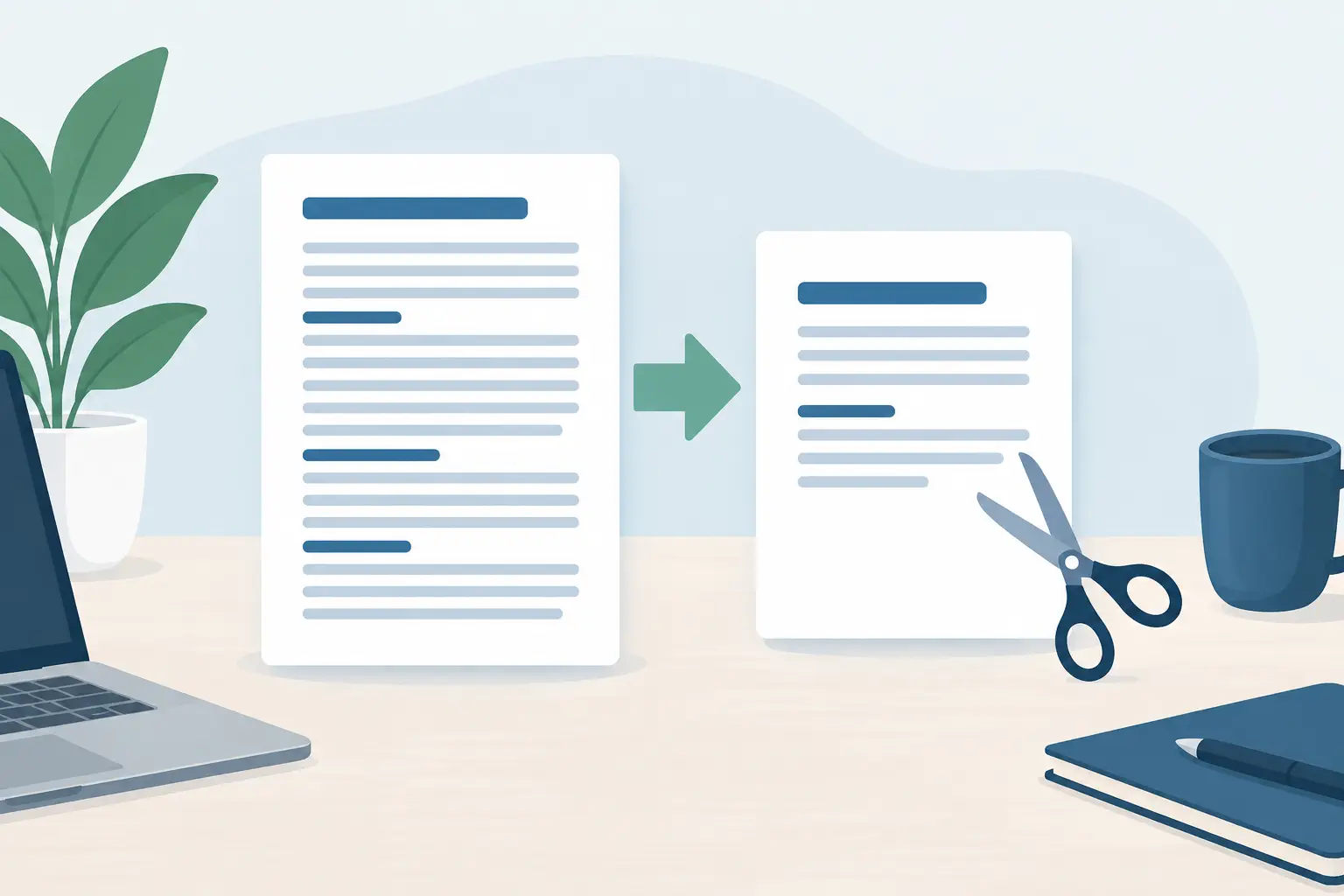
A 2,000-word draft for a 1,500-word assignment is not a small editing problem. It is a decision problem. You have to shorten an essay without losing meaning, which means cutting words while keeping the claim, evidence, logic, and your voice intact.
The bad approach is deleting random sentences until the word count looks acceptable. That is how transitions disappear, citations get separated from claims, and a paper starts reading like a set of disconnected notes. The better approach is to cut by priority: remove what repeats, tighten what rambles, and protect what proves your point.
How to Shorten an Essay Without Losing Meaning
Start by identifying what the essay must still do when it is shorter. Every academic paper has a core job: answer the prompt, make a defensible claim, and support it with relevant evidence. If a paragraph does not help with one of those jobs, it is a candidate for a cut.
Before editing a single sentence, write your thesis in one plain sentence. Then write one short purpose statement for each body paragraph. For example: “This paragraph shows how the policy affected low-income renters.” If you cannot explain a paragraph's purpose clearly, the paragraph may be unfocused, repetitive, or doing too much at once.
This quick map prevents panic-cutting. It tells you which material is essential and which material is just taking up space.
Protect the parts that carry your grade
Do not treat every word equally. Your thesis, topic sentences, source evidence, analysis, and citations need more care than scene-setting or broad background. A shorter paper can still be strong if its reasoning is visible. A long paper with vague reasoning is still vague.
Keep direct quotations only when the exact wording matters. This is common when analyzing language, defining a key term, or using a source with especially precise phrasing. If you only need the source's idea, paraphrase it accurately and retain the citation. You often save 20 to 50 words this way without losing academic credibility.
Be careful with quotations you decide to keep. Never trim words in a way that changes the author's meaning, and do not remove the citation just because the sentence has become shorter. Your sources are not filler. They are part of the evidence chain.
Cut repetition before cutting ideas
Most over-length essays are not too full of ideas. They are too full of the same idea stated several times.
Look for repetition across the introduction, topic sentences, and conclusion. Students often announce a point in the introduction, restate it at the beginning of a paragraph, explain it again after the quote, then repeat it in the conclusion. Some reinforcement is useful. Four versions of the same sentence are not.
Here is the difference:
“Social media has had a significant and major impact on the ways that college students communicate with one another.”
“Social media has changed how college students communicate.”
The second version says the same thing with fewer words. More importantly, it sounds more confident. Phrases like “significant and major,” “in the ways that,” and “with one another” add length without adding meaning.
Also watch for paragraph endings that simply repeat the topic sentence. Replace the repetition with analysis, a transition, or nothing at all. Not every paragraph needs a final sentence if the next paragraph flows naturally from the evidence.
Tighten Sentences, Not Just Paragraphs
Once you have removed repeated ideas, edit at the sentence level. This is where you can save meaningful space without weakening the paper.
Start with phrases that can become one word. “Due to the fact that” becomes “because.” “In order to” becomes “to.” “At this point in time” becomes “now.” “Has the ability to” becomes “can.” These are small changes, but across a draft, they add up fast.
Next, look for weak openings. “It is clear that,” “it should be noted that,” and “there are” often delay the actual point. Instead of writing, “It is clear that the author uses imagery to create tension,” write, “The author uses imagery to create tension.” Your reader does not need a warning that your analysis is about to begin.
Passive voice is not automatically wrong, especially in scientific or formal writing. But it can hide the actor and add extra words. Compare “The survey was conducted by the research team” with “The research team conducted the survey.” Use the version that makes the action clearer.
Choose specific verbs over extra adjectives
When a sentence feels wordy, the problem is often the verb. Weak verbs force you to pile on adjectives and adverbs.
“The company made a decision to reduce its workforce” can become “The company reduced its workforce.” “The character is very afraid of the consequences” can become “The character fears the consequences.” Specific verbs make academic writing cleaner without making it sound less like you.
Do not overcorrect into stiff, stripped-down writing. A literature essay may need descriptive language. A reflection may need personal detail. The goal is not to sound mechanical. The goal is to make every phrase earn its place.
Reduce Background Without Losing Context
Background is where word counts quietly disappear. You may know a lot about the topic, and it is tempting to show all of it. But your professor is grading your response to the assignment, not the amount of research you managed to collect.
Ask whether each context sentence helps the reader understand your argument right now. A two-sentence explanation of a historical event may be necessary. A full timeline probably is not, unless the timeline is the argument.
The same rule applies to definitions. Define a term when your reader needs it to follow your analysis. Do not spend a whole paragraph defining a familiar concept just to reach the word count you used to have. One accurate, cited definition is usually enough.
If you are cutting a research paper, keep the context closest to the evidence. Instead of giving five sentences of general background in the introduction, move one necessary detail into the paragraph where it explains a source or result. Your paper will feel less front-loaded and more focused.
Combine Evidence That Makes the Same Point
Two sources do not automatically make an argument twice as strong. If both studies support the same narrow claim, you may be able to cite them in one sentence rather than explain each one in separate paragraphs.
For example, instead of summarizing two articles one after another, name the shared finding and then explain why it matters for your thesis. This preserves research depth while giving your own analysis more room.
There is a trade-off. Do not combine sources if their methods, conclusions, or limitations differ in a way that matters. A quantitative study and a personal interview may support a similar point, but they offer different kinds of evidence. If that difference is central to your argument, keep the distinction.
Use a Rewriting Tool as an Editor, Not a Substitute
A rewriting tool can help you spot long phrasing, repeated language, and clunky transitions, especially when you have been staring at the same draft since midnight. But the final decisions should stay yours.
If you use Bypassify's AI Rewriter, work in small sections and compare the rewrite against your original. Check that citations, quotations, names, numbers, and the claim itself remain accurate. A shorter sentence is only better if it still says what you meant to say. Your meaning stays yours.
This matters most in source-heavy assignments. Generic rewriting can flatten careful distinctions or alter a paraphrase enough that it no longer matches the source. Read the revised sentence beside the original source before you submit, particularly when the evidence is complex or the wording has legal, scientific, or historical significance.
Do a Final Meaning Check
After cutting, read the essay once without editing. You are looking for gaps created by the revision: a pronoun with no clear noun, a conclusion that mentions a point you deleted, or a transition that now jumps too far.
Then check three things. Can someone identify your thesis quickly? Does every body paragraph provide evidence and explain its relevance? Are all quotations and paraphrases still cited correctly? If the answer is yes, the shorter draft is probably stronger than the longer one.
Word limits are not asking you to make your thinking smaller. They are asking you to make your thinking clearer. Cut the extra setup, keep the proof, and leave your reader with the version of the argument that matters most.
Write it once. Let Bypassify keep it human.
The free browser extension humanizes or rewrites whatever you select, in any tab, using your own Writing DNA.