
How to Preserve Citations When Rewriting
Learn how to preserve citations when rewriting essays, keeping sources, quotes, page numbers, and your voice intact through final edits before you submit.
Free account · 5 runs a day · No card needed
Test your own draft in the Humanizer in about 20 seconds.
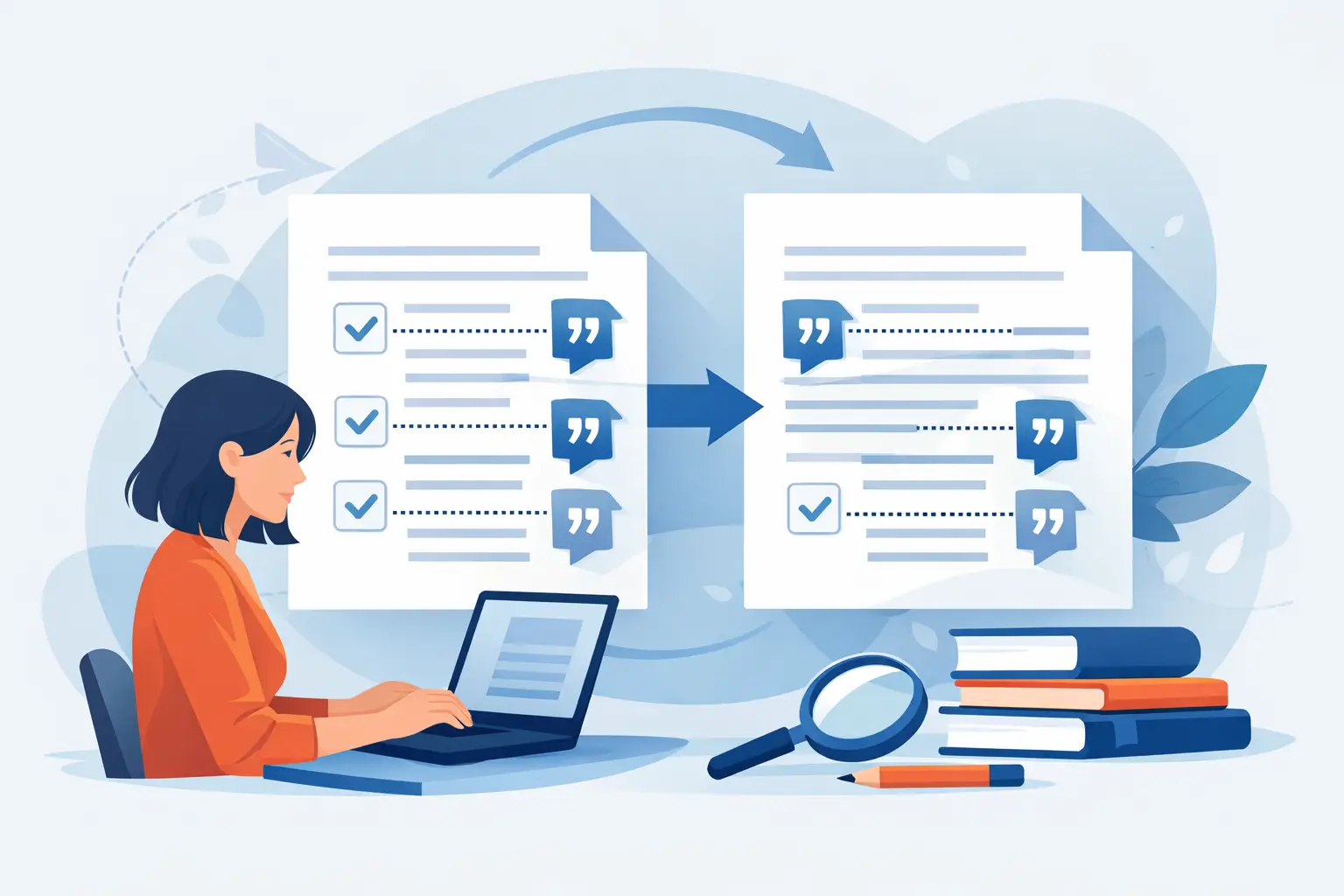
A rewrite can make an awkward paragraph sound clear and confident in seconds. It can also quietly turn a solid research paper into a citation mess: a source disappears, a page number gets moved, a direct quote is altered, or a claim now says more than the evidence supports.
Knowing how to preserve citations when rewriting is not just a formatting skill. It is how you protect your research, your credibility, and the work you already put into finding good sources. Your wording can change. Your evidence still has to mean exactly what it meant before.
Why citations break during a rewrite
Citations are easy to treat like decorations at the end of a sentence. In academic writing, they are more like anchors. They tell your professor where an idea, statistic, interpretation, or exact wording came from.
The problem is that rewriting changes sentence structure. A rewriter may split one sentence into two, combine several claims, move a phrase to a new paragraph, or replace a precise verb with a broader one. If the citation stays in its old spot, readers may no longer know which claim it supports.
That can create three different problems. First, you may accidentally make a source look like it supports an argument it never made. Second, you might lose required details such as an author name, year, chapter, or page number. Third, a quotation can become inaccurate if its wording changes even slightly.
This is why a polished paper still needs a source check. Better flow is great. Broken attribution is not.
Start with a citation-safe draft
Before you rewrite anything, make a clean copy of the draft you are working from. Keep your original version somewhere private and untouched. This gives you a real comparison point if a citation vanishes or a paragraph starts sounding like it makes a different claim.
Then identify the parts that should not be freely rewritten. These usually include direct quotes, in-text citations, reference list entries, URLs, DOI numbers, research statistics, study titles, legal case names, dates, and proper nouns. Treat these as protected text.
For example, this sentence contains several details that need to survive intact:
> In a 2023 survey, 62% of first-year students reported using campus tutoring services at least once (Lopez, 2023, p. 14).
You can rewrite the surrounding prose. You should not casually change the percentage, year, author, or page number. If you change the claim from “reported using” to “regularly relied on,” you also need to reopen the source and make sure that stronger wording is justified.
Rewrite the claim, then reconnect the source
The safest approach is simple: rewrite one claim at a time, then check that its citation still follows the claim it supports.
Say your original sentence reads:
> Social media can increase political participation among younger voters by making campaign information easier to share (Nguyen, 2022).
A clearer version might be:
> By making campaign information easier to circulate, social media may encourage more young people to participate politically (Nguyen, 2022).
The wording changed, but the meaning stayed close. The citation remains attached to the same idea.
Now consider this rewrite:
> Social media has transformed young voters into more informed and active citizens (Nguyen, 2022).
That sounds smoother, but it is riskier. “Transformed” is a huge claim. “More informed” may not be something Nguyen measured at all. The citation is still there, yet it may no longer be accurate. A citation only protects you when the source actually supports the sentence beside it.
This is where many last-minute edits go wrong. The citation survives visually, but the evidence connection does not.
Be extra careful with sentences that contain multiple sources
A paragraph can look well-cited while still being confusing. If one sentence includes two or three different studies, make it obvious which source supports which point.
Instead of writing a long sentence with three claims and one citation cluster at the end, separate the evidence:
> Sleep loss can reduce attention during lectures (Patel, 2021). It may also affect memory consolidation after studying (Reed & Kim, 2020).
This is not always the most elegant style, but it is clearer. Once the claims are separated, you can revise for flow without guessing where citations belong.
Keep direct quotes exactly exact
A direct quote is not a paraphrase with quotation marks around it. Every word inside the quotation marks should match the original source, except for clearly marked changes allowed by your citation style.
Do not use a rewriting tool to “improve” a quote. Do not swap in synonyms to make it sound less formal. Do not fix grammar unless your style guide allows it and you show the edit correctly. If the quote feels clunky, introduce it differently or paraphrase the idea instead - after checking the source closely.
For example, if a researcher writes, “Students often mistake speed for understanding,” you cannot change it to, “Students frequently confuse fast work with learning,” and keep quotation marks. That is a paraphrase. Remove the quotation marks, write it in your own voice, and cite the source.
Also watch for partial quotes. A rewrite can accidentally remove the words that gave a statement context. Pulling a sharp phrase from a cautious finding can make a study sound more certain than it was. Read the sentence before and after the quoted passage in the original source before you submit.
Paraphrasing still needs a source check
Paraphrasing is where your voice matters most. It is also where students can unintentionally drift from what a source says.
A strong paraphrase does more than replace a few words. You read the source, understand the idea, put it aside, and explain the point in language that fits your argument. Then you cite the original author because the idea is still theirs.
After rewriting a paraphrase, ask yourself two questions: Did I preserve the source’s actual point? And did I add a claim that the source does not prove?
That second question matters when you are trying to sound more persuasive. Academic writing does not need to be weak, but your confidence should come from accurate reasoning, not inflated evidence.
If a study finds a correlation, keep it a correlation. Do not rewrite “is associated with” as “causes.” If an author studied 200 students at one university, do not make the result sound universal. Small wording changes can create major accuracy problems.
Use AI rewriting tools with protected details in mind
AI can help when your draft is repetitive, stiff, or packed with sentences that sound nothing like you. But a generic rewrite should never be your final fact-check.
Before using any tool, keep citations and quotes visible in the text. Do not paste only the paragraph body and plan to add sources back from memory later. That is how page numbers disappear and citations end up attached to the wrong sentence.
Choose settings that prioritize meaning and keep an eye on changes through side-by-side or inline comparison. A good academic workflow lets you see what changed instead of asking you to trust a fresh block of text. With Bypassify, for example, students can rewrite for clarity and natural voice while keeping citations, quotations, names, numbers, and other research details protected.
Even then, review the output yourself. Tools can preserve text, but they cannot replace your judgment about whether a source supports your revised argument.
Run a fast citation audit before submitting
You do not need another three-hour editing session. You need a focused pass through the evidence in your paper.
Work from the first paragraph to the last. Each time you see a citation, pause and identify the exact claim it supports. If you cannot tell within a few seconds, revise the sentence or move the citation closer to the relevant idea.
Next, search for every quotation mark. Compare each quote against the original source and confirm that its citation has the correct locator, such as a page number or paragraph number when required. Then compare every in-text citation to your references page. Each source cited in the paper should appear in the reference list, and each reference list entry should be used in the paper unless your instructor says otherwise.
Finally, check the high-risk details: numbers, dates, sample sizes, titles, and author names. These are the details most likely to get altered when a sentence is shortened or rewritten for style.
Make the final version sound like you
Your professor should be able to follow your thinking from claim to evidence to analysis. Citations make that trail visible. Good rewriting makes the trail easier to read.
Keep your sources close to the ideas they support, keep quotes faithful to the original, and let your own analysis do the connecting. The best final draft is not the one that sounds most polished at any cost. It is the one where your voice is clearer, your research is still intact, and every source earns its place on the page.
Ready to fix your own draft?
Paste a paragraph and see the result in seconds. Quotes and citations stay exactly as you wrote them, and your drafts stay private.
- 5 free runs a day
- No card needed
- Citations kept