
Expand Paragraph Without Changing Meaning
Learn how to expand paragraph without changing meaning with evidence, explanation, and transitions that make essays clearer, stronger, and still yours.
Free account · 5 runs a day
Humanize your own draft in about 20 seconds.
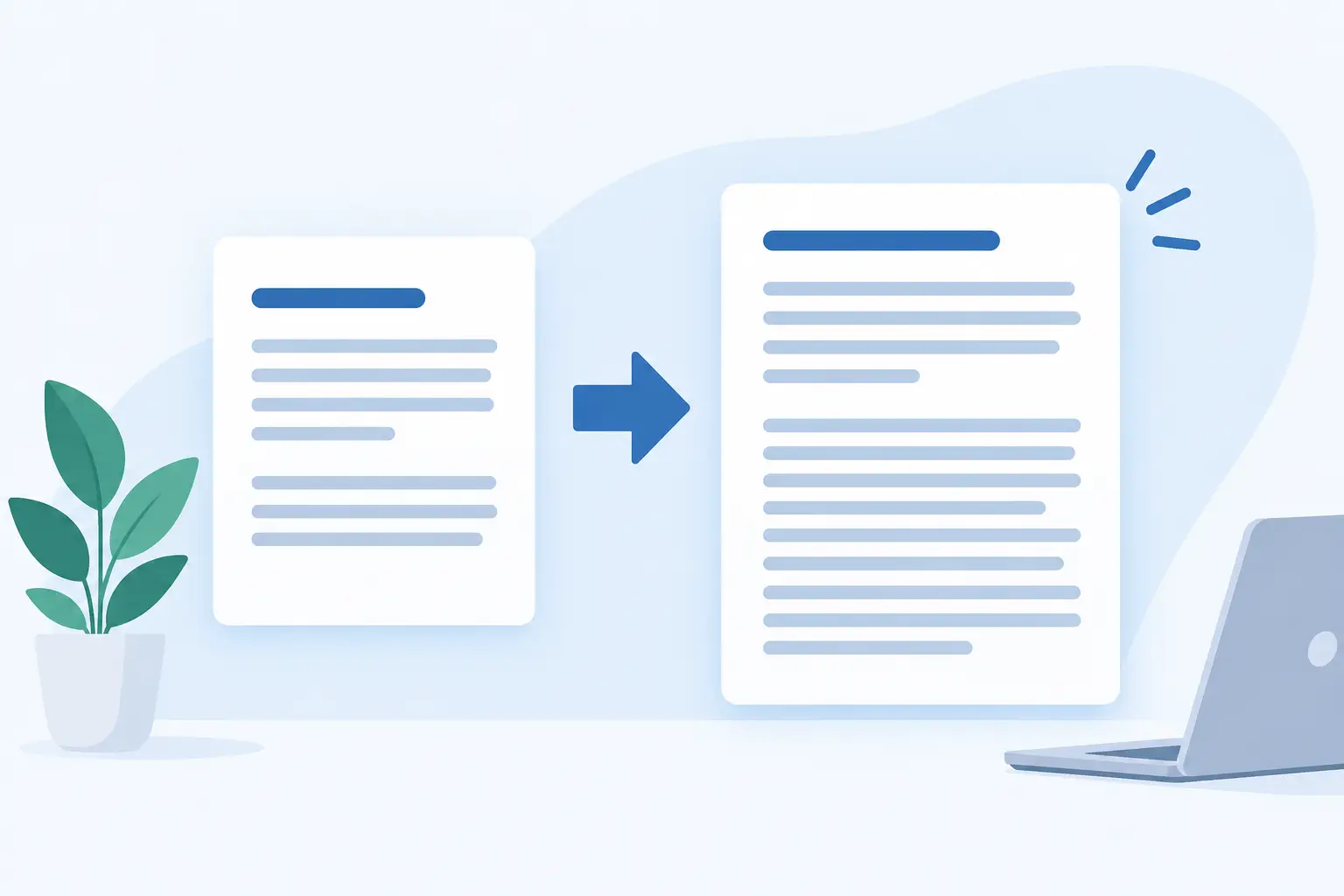
A short paragraph can make a solid point and still leave your professor with questions. Why does that example matter? How does the evidence prove the claim? What connects one sentence to the next? Learning how to expand paragraph without changing meaning solves that problem without turning your paper into padded filler.
The goal is not to say the same thing five different ways. It is to give your original idea the support, context, and explanation it needs. Your meaning stays yours. It just becomes easier for someone else to follow.
What expansion should actually do
A stronger paragraph does more than take up more space. It helps the reader understand your claim, see the evidence behind it, and recognize why that evidence belongs in your argument.
Think of a paragraph as a small argument. Most academic paragraphs need a clear point, proof or an example, an explanation of that proof, and a link back to the larger topic. If yours only has the point and proof, expansion usually means adding the missing reasoning - not adding extra adjectives.
For example, this paragraph has a real idea but stops too soon:
> Remote work can improve employee satisfaction. It gives workers more flexibility and reduces commuting stress.
An expanded version could read:
> Remote work can improve employee satisfaction because it gives workers greater control over how they organize their day. For employees with long commutes, working from home can also remove a daily source of time pressure and stress. This flexibility may make it easier to balance work responsibilities with family obligations, appointments, or focused tasks that are harder to complete in a busy office. As a result, remote work can support a more sustainable routine for some employees.
The main meaning did not change: remote work may improve satisfaction through flexibility and less commuting stress. The new sentences explain the connection and show its implications.
Expand a paragraph without changing meaning: start with the core claim
Before adding anything, identify what the paragraph already says in one sentence. This is your boundary. Every new sentence should clarify, support, illustrate, or logically extend that statement.
Ask yourself three quick questions: What is my point? What evidence or reason do I already give? What would a skeptical reader still need explained?
That last question is especially useful in essays and research papers. A reader may understand the words in your source, but they cannot automatically see why the quote supports your thesis. That explanation has to come from you.
If the paragraph argues that social media affects political participation, do not expand it by switching into a broader argument about whether social media is harmful. That may be interesting, but it changes the paragraph's job. Stay close to the claim you already made.
Add explanation after evidence
The easiest place to expand an academic paragraph is directly after a fact, statistic, quotation, or example. Evidence does not speak for itself, even when it feels obvious to you.
Say your draft includes this sentence:
> A 2023 campus survey found that students who attended review sessions reported higher confidence before exams.
You could add explanation like this:
> This finding suggests that review sessions may help students feel more prepared because they create a structured space to revisit difficult material and ask questions before test day. Higher confidence does not automatically guarantee a better grade, but it can reduce uncertainty and encourage students to use more effective study strategies.
Notice the restraint. The added lines do not claim that review sessions magically raise every student's score. They explain the reasonable significance of the survey while keeping the original point intact.
This is also where many writers accidentally distort sources. If a study says two things are associated, do not expand the paragraph by claiming one caused the other. Keep the same level of certainty as the original source. Words like suggests, may, and is linked to can protect accuracy when the evidence is limited.
Use the why, how, and so what test
After each important sentence, try one of these prompts:
- Why is this true or significant?
- How does this example support my point?
- So what does this mean for my larger argument?
You do not need to answer all three every time. One well-written answer can add more value than three repetitive sentences.
Give the reader useful context
Context can expand a paragraph without changing its meaning because it helps readers understand the conditions around an idea. In a literature paper, that might mean briefly identifying a character's situation before analyzing a quote. In a research paper, it could mean defining a key term or explaining why a study's sample matters.
For instance, instead of writing, The policy was unpopular, add the relevant context:
> The policy was unpopular among students because it required all first-year residents to purchase a campus meal plan, including students who had dietary restrictions or limited dining options near their residence halls.
This is not random detail. It tells the reader why the reaction happened.
Be selective, though. A paragraph does not need every fact you found while researching. If a detail does not make the claim clearer or make the evidence easier to interpret, leave it out. More words are not automatically more persuasive.
Use an example, but make it earn its place
Examples are useful when your idea is abstract. They turn a general statement into something a reader can picture.
A sentence such as Clear communication improves group projects is true but broad. You could expand it by showing what clear communication looks like:
> Clear communication improves group projects by making responsibilities visible from the beginning. For example, a team that assigns research, outlining, drafting, and editing tasks before the first deadline is less likely to duplicate work or realize too late that a major section is missing.
The example supports the claim rather than taking the paragraph in a new direction. That is the standard to use.
Build smoother connections between sentences
Sometimes a paragraph feels short because it jumps from claim to evidence to conclusion too fast. A transition can slow the movement just enough for the logic to land.
Useful transitions include for example, in contrast, as a result, because of this, more specifically, and at the same time. Pick one based on the relationship between your ideas. Do not add transitions just to sound academic. If the connection is unclear, fix the thinking first.
Compare these versions:
> College students often sleep less during finals week. Many also report trouble concentrating.
> College students often sleep less during finals week. As a result, many may have more difficulty concentrating during long study sessions and exams.
The second version makes the relationship explicit. It adds clarity without making a bigger claim than the original supports.
What to avoid when making a paragraph longer
The fastest way to weaken a paper is to confuse expansion with repetition. Watch for sentences that restate the same claim with slightly different wording, vague intensifiers like very or really, and side points that deserve their own paragraph.
Also avoid adding unsupported claims just because they sound convincing. If you write that a policy affects every student, improves outcomes, or proves a larger trend, make sure your source actually supports that conclusion. Your citations, quotations, names, statistics, and factual details should remain exactly right.
This matters even more when you use a writing tool. A good rewriter should help you develop your explanation while preserving the facts that make academic work credible. Bypassify is designed for that kind of careful revision, helping you improve flow and expand ideas while protecting your meaning, citations, and voice.
A quick revision method for deadline mode
Read one paragraph and underline the sentence that makes the main claim. Circle the evidence. Then look for the gap between them. Is the reader told why the evidence matters? Is there enough context to understand it? Does the final sentence connect back to your thesis or set up the next point?
Add one or two sentences only where there is a real gap. Then reread the paragraph without looking at the original. If the added material makes the point clearer, keep it. If it only makes the paragraph longer, cut it.
The best expanded paragraphs do not feel expanded. They feel complete - like you gave your reader the exact amount of reasoning they needed to see your point and trust it.
Write it once. Let Bypassify keep it human.
The free browser extension humanizes or rewrites whatever you select, in any tab, using your own Writing DNA.