
Why Was My Human Writing Flagged as AI? (And How to Fix It)
Discover why your original essay was flagged as AI generated text and learn practical editing steps to fix false positives before turning in your work.
Have a draft to refine? Try the Humanizer free, citations kept intact. No card needed.
Start free →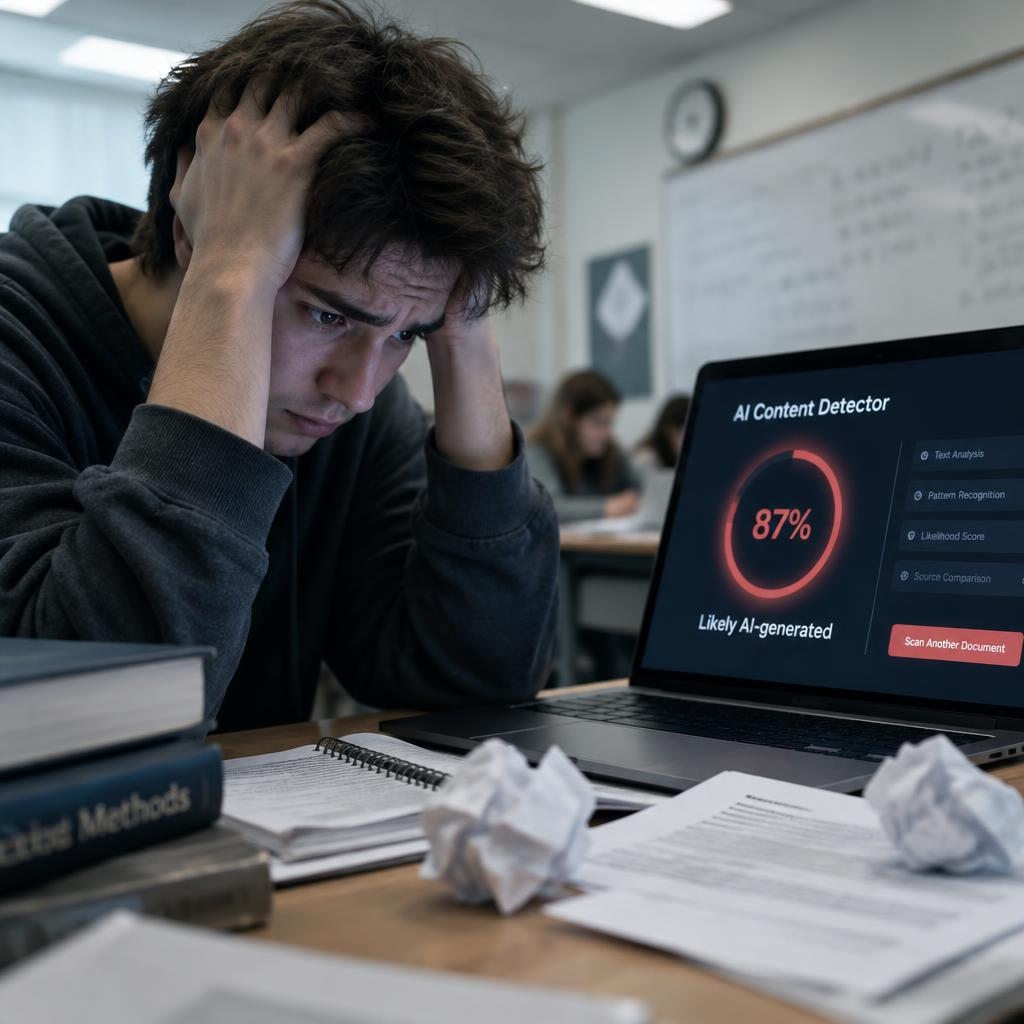
Why Was My Human Writing Flagged as AI? (And How to Fix It)
Human writing gets flagged as AI when your prose displays high predictability and uniform sentence structure. AI scanners evaluate statistical metrics like perplexity and burstiness. If your sentences share similar lengths, standard academic transitions, and neutral phrasing, automated detectors conclude the text was machine generated despite your genuine effort.
Receiving a false accusation on an essay you spent days researching is deeply frustrating. You sat at your desk, compiled citations, organized arguments, and wrote every sentence from scratch. Yet a detector insists your work belongs to a computer.
Understanding why this happens is the first step toward clearing your name and making your natural voice shine through your drafts.
Why AI Detectors Make Mistakes on Authentic Writing
AI detectors do not check a database of registered machine text. Instead, they estimate probability using two primary metrics: perplexity and burstiness.
Perplexity measures how unusual word choices are. If a detector can guess your next word with high accuracy, perplexity drops. Burstiness measures variation in sentence rhythm, length, and complexity. Human beings naturally write in bursts. We follow a thirty-word compound sentence with a crisp four-word observation. We pause, qualify ideas, and change cadence.
When you write in an academic setting, you are taught to do the exact opposite. You are told to remain objective, avoid colloquialisms, use passive constructions, and connect points with formal signposts like furthermore, moreover, and in conclusion.
Because large language models were trained on millions of formal academic papers, they write in that exact style. When you follow textbook academic conventions perfectly, an automated scanner assumes you are an algorithm.
| Human Trait vs. Detector Expectation | Typical Human Draft | Machine Pattern Flagged by Scanners | | :--- | :--- | :--- | | Sentence Length | Irregular mix of very short and long sentences | Uniform medium to long sentences | | Transitions | Conversational flow, paragraph-level logic | Mechanical signposts (moreover, consequently) | | Tone | Specific perspective, distinct authorial voice | Flat, perfectly neutral, risk-averse summaries | | Vocabulary | Concrete details mixed with simple phrases | Elevated, generic vocabulary (foster, underscore) |
Common Habits That Trigger False Positives
Even when your research is original, certain writing habits dramatically increase your risk of a false positive.
1. Overusing Prescriptive Transitional Words
Academic rubrics often demand clear transitions. However, dropping furthermore, additionally, thus, or in summary at the front of every paragraph signals mechanical composition to an automated parser.
2. Standardized Vocabulary Choices
Words like delve, pivotal, testament, tapestry, and multifaceted are over-represented in modern language models. If your vocabulary relies heavily on these convenient academic staples, scanners flag your paragraphs.
3. Over-Polishing Through Automated Grammar Checkers
Standard grammar software aims to eliminate idiosyncrasies. When you accept every stylistic adjustment an automated tool recommends, you strip away the natural unevenness of human prose. The resulting draft reads cleanly, but it also matches the exact statistical baseline of an AI model.
If you want your draft to retain its natural voice while maintaining rigorous clarity, tools like the Bypassify Humanizer help restore human cadence to overly rigid drafts without compromising your original arguments.
How to Fix Writing That Got Flagged: A Step-by-Step Guide
When your draft triggers an alert, you do not need to discard your thesis. You can restore your authentic voice with deliberate structural edits.
- Vary your sentence boundaries aggressively. Read your paragraph aloud. If three sentences in a row hover around twenty words, split one into two short assertions. Join another with a semicolon or comma. Creating sharp contrast in rhythm immediately raises burstiness.
- Replace stock connectors with direct logical links. Eliminate furthermore and moreover. Let the argument carry itself, or tie the opening of the sentence directly to the noun in the previous line.
- Insert precise historical or contextual details. AI models tend to speak broadly. When you replace generalized summaries with specific figures, named archival sources, or unique classroom examples, the predictability score collapses.
- Sharpen your tone and stance. Instead of remaining entirely passive, state your conclusions directly. Own your analysis. A distinct, confident voice is far harder for a detector to classify as generic synthetic text.
- Run a clarity pass with targeted editing tools. To clean up convoluted syntax without flattening your natural rhythm, run the draft through the Bypassify Rewriter. It improves tone and grammar while maintaining your exact quotes and factual claims.
Before and After: Reclaiming Human Cadence
Review how a formal, easily flagged passage can be rewritten to maintain scholarly rigor while breaking predictable machine patterns.
Flagged Human Draft:
Furthermore, it is crucial to recognize that renewable energy adoption faces significant economic barriers. Additionally, municipal governments often lack the initial capital required for infrastructure overhauls. Consequently, long-term sustainability initiatives are frequently delayed.
Why it gets flagged: Three consecutive sentences of similar length, each opened by a standard transitional adverb, stating general truths in a passive construction.
Revised Human Draft:
Clean energy transitions sound straightforward on paper, but local budgets tell a different story. Most city councils simply lack the upfront millions needed to rewire their power grids. Because the financial return takes decades to materialize, ambitious climate deadlines quietly slip off the legislative calendar.
Why it passes: The sentences vary dramatically in cadence. Concrete terms like city councils and upfront millions replace generic terms like municipal governments and economic barriers.
Checklist for Submitting AI-Safe Human Writing
Run through this quick checklist before submitting your next major paper:
- Have you checked your version history to confirm your drafting process was saved?
- Are your sentence lengths mixed, including at least one short sentence per paragraph?
- Did you remove excessive uses of furthermore, moreover, and crucial?
- Are all direct quotations matched precisely to primary texts?
- Does your conclusion provide a clear point of view rather than a robotic restatement?
- Have you verified how your text reads by consulting how Bypassify works to support clean editing?
Take Action on Your Draft Today
A false positive flag is an invitation to edit for character and clarity, not a reason to panic. Take twenty minutes right now to read your paper aloud, break apart uniform sentences, and restore your natural human rhythm.
Frequently asked questions
Can AI detectors falsely accuse 100 percent human writing?
Yes. AI detectors rely on statistical models measuring sentence uniformity and predictability rather than definitive proof. When human writers use formal vocabulary, rigid structures, or neutral tones, detectors frequently flag the text as artificial.
What is the fastest way to fix text flagged as AI?
Vary your sentence lengths immediately. Break apart rigid compound sentences, insert brief statements, replace generic transition words like furthermore with natural connective thoughts, and integrate your personal analysis.
Why do non native English speakers get flagged more often?
Writers using English as an additional language often rely on textbook grammar rules and repetitive transitional phrases taught in standard curricula. Because language models are trained on similar conventional patterns, their authentic work triggers high probability scores.
How can I prove to my instructor that I wrote the paper myself?
Keep your document version history active in Google Docs or Microsoft Word to show gradual progress over time. You can also share early outlines, rough notes, cited sources, and the research trails you used during drafting.
Does editing with grammar checkers trigger AI detection?
Automated grammar tools frequently suggest predictable word substitutions and standard sentence constructions. If you accept every automated suggestion across a paper, the uniform sentence cadence can cause an AI scanner to mistake your writing for machine output.
Ready to fix your own draft?
Paste a paragraph and see the result in seconds. Quotes and citations stay exactly as you wrote them, and your drafts stay private.
- 5 free runs a day
- No card needed
- Citations kept