
How to turn messy research notes into clear paragraphs
Turn scattered research notes into focused paragraphs while protecting your evidence, keeping your voice, and understanding detector limits.
Free account · 5 runs a day
Humanize your own draft in about 20 seconds.
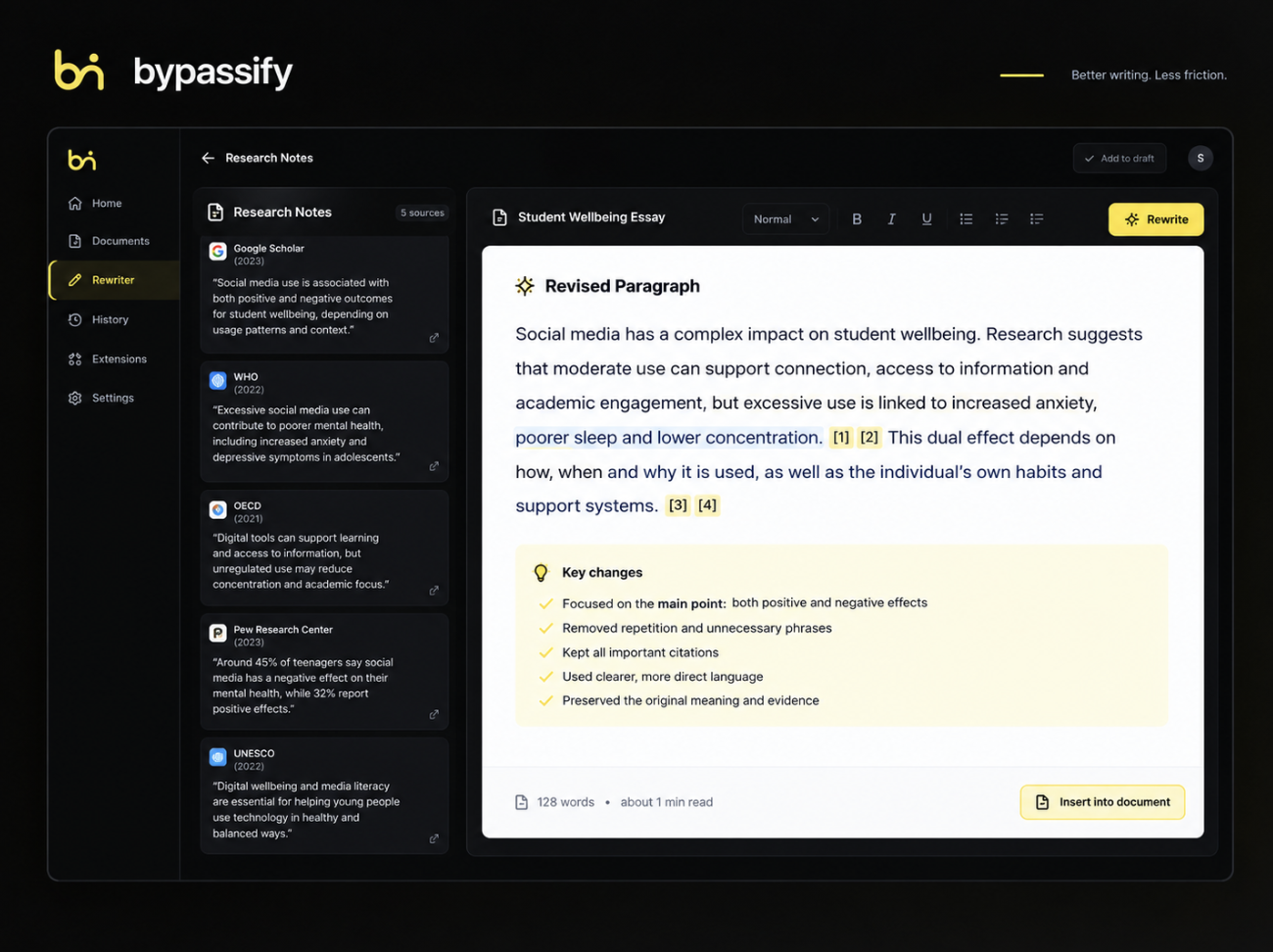
Start with the point, not the pile
Messy research notes are a storage system, not a draft. They can contain copied passages, half-formed arguments, page references, objections, and reminders in the same list. Trying to polish that list sentence by sentence usually produces a paragraph with too many jobs.
Start by asking: What should your reader understand after this paragraph? Write the answer in one plain sentence. That sentence gives you a reason to include some notes and leave others out.
If you worry that your genuine work sounds machine written, this is also a better starting point than a detector score. Your immediate task is to make your reasoning visible, not to make your prose pass a test.
Separate evidence from your interpretation
Before drafting, label your notes by function. You do not need a complicated system. Four labels will handle most research material:
- Evidence: a finding, example, observation, or source claim.
- Exact quote: copied wording that must remain unchanged.
- Interpretation: what you think the evidence means.
- Question: something you still need to verify or explain.
Keep the source identifier and page or section reference attached to each evidence note. Moving a useful sentence into a new document without its reference creates avoidable detective work later.
Also distinguish what a source says from what you infer. A note that begins with “This might suggest” should not become “The research proves” during revision.
If you cannot tell whether wording was copied or paraphrased, return to the source. Do not guess and then edit the sentence until it looks original. You need to know what you are working with before you can use it responsibly.
Sort notes by the question they answer
Your notes may be organized by reading order: one source, then another, then another. Your paragraph usually needs a different order, based on the point you are making.
Put related notes together under questions such as:
- What is the main finding or idea?
- What supports it?
- What limits it?
- Why does it matter for this argument?
A note can be relevant to your topic without belonging in the current paragraph. Give those notes a separate holding area so you can remove them without feeling that you are throwing away research.
When sources disagree, keep the disagreement visible. Check whether they examine different groups, use different definitions, or answer different questions. If your notes do not explain the difference, mark it as unresolved rather than inventing a connection.
Build a paragraph around one task
A reliable paragraph often contains four moves: a point, support, explanation, and a qualification or consequence. Treat these as questions to answer, not four compulsory sentences.
State the point
Open with the idea the paragraph will establish. Avoid using the first sentence merely to announce that a topic exists.
Before: There are several important considerations regarding the organization of research notes.
After: Sort research notes by the question they answer, not just by the source they came from.
The revised sentence gives your reader something specific to understand. It also helps you decide what belongs next.
Add support and explain its role
Introduce the evidence that supports your point, with its citation attached. Then explain the connection. Do not assume your reader will interpret a quotation or finding exactly as you did.
Useful drafting prompts include “This supports the point because…” and “The important distinction here is…”. You can remove those phrases later if they sound repetitive. Their job is to expose a missing reasoning step.
Keep the limits
Preserve qualifications about the population, conditions, timeframe, or strength of a finding. A shorter sentence is not an improvement if it makes a narrower claim sound universal.
As a sentence-level template, “X was associated with Y in this sample” should not become “X causes Y.” The second version changes both the relationship and the scope.
If the paragraph needs a second main claim to explain all the notes, consider splitting it.
See how rough notes become connected prose
Here is a small example using editing advice rather than research findings, so no source evidence is being invented.
Rough notes:
- Group by question, not reading order.
- Keep references attached.
- Some relevant notes belong elsewhere.
- Explain why the evidence supports the point.
Paragraph:
Group your research notes by the question each paragraph needs to answer. Keep source references attached as you move material, so you can trace every claim back to its evidence. Put relevant notes that answer a different question in a separate section. Once you have selected the evidence, explain how it supports your point rather than leaving the reader to make that connection.
The paragraph adds relationships, not new facts. Each sentence performs a different job, and the order follows the work you need to do.
For an actual research paragraph, support statements about your subject with verified evidence and citations. A fluent transition cannot substitute for that support.
Edit in separate passes
Trying to fix logic, references, grammar, and voice at once makes it easy to miss a changed claim. Use separate passes instead.
Check meaning and evidence first
Compare your draft with the original sources, not just your abbreviated notes. Check exact quotations character by character, and make sure each citation clearly supports the nearby statement.
Watch for small words with large consequences: “may,” “only,” “some,” and “under these conditions.” Removing them can change what your paragraph asserts.
Improve flow and voice second
Read the paragraph aloud. Notice where you run out of breath, repeat an idea, or use wording you would struggle to explain in conversation.
The Bypassify Rewriter can help improve clarity, grammar, flow, and tone while keeping your meaning, quotes, and citations exact. Use it on your own drafted paragraph, then compare the result with your original.
If your draft was AI assisted and feels stiff, the Bypassify Humanizer can help it read more naturally while preserving those same elements. Treat either tool as editing help, not as a source of missing evidence. Follow your institution's or publisher's rules for AI assistance.
Understand what detectors can and cannot tell you
AI detectors estimate whether text resembles patterns associated with machine-generated writing. Depending on the system, they may assess word predictability, recurring phrasing, sentence patterns, or features learned from training examples.
Those signals overlap with human writing. Formal research prose can be predictable, and careful writers can use repeated structures. Different tools can also return different judgments on the same passage.
No detector is exact. A displayed percentage is not necessarily a calibrated probability that a person used AI. It cannot, by itself, establish authorship.
Do not add errors, random synonyms, or awkward sentences to chase a different score. Instead, check whether your argument is specific, your evidence is traceable, and your explanations are genuinely yours. Keep source annotations, outlines, and draft history as a record of your process, not as a guarantee against questions.
Check the paragraph before moving on
Use this short checklist:
- Does the paragraph establish one clear point?
- Can you trace each evidence claim to its source?
- Are exact quotes and citations unchanged?
- Have you explained the evidence without overstating it?
- Does every sentence help your reader follow the argument?
Write one purpose sentence now
Choose one cluster of notes and write the sentence: “This paragraph needs to show that…” Finish the thought before polishing anything. That single decision will tell you which notes to use, which to set aside, and where your reasoning still needs work.
Frequently asked questions
What is the first step in turning messy notes into a paragraph?
Write one sentence stating what the paragraph needs to establish. Then select only the notes that support, explain, or qualify that point, keeping their source details attached.
How do I combine notes from several sources without losing citations?
Keep each note connected to its source while you sort it by topic. When drafting, place citations beside the claims they support rather than collecting them at the end of a paragraph with unclear scope. Check every paraphrase against the original passage.
Can an AI detector flag something I wrote myself?
Yes, a detector can misclassify human writing. Detectors estimate patterns associated with different kinds of text, but those patterns are not exclusive to AI writing. A score alone cannot establish who wrote a passage.
Should I add mistakes to make my writing seem more human?
No, deliberate mistakes make your work less clear without proving authorship. Focus on precise claims, useful explanations, and wording you would actually choose. Keep notes and drafts as a record of your writing process.
Can Bypassify help turn my notes into finished paragraphs?
First organize your own notes and draft the argument so the evidence and your interpretation are clearly separated. You can then use the Rewriter for clarity, grammar, flow, and tone, or the Humanizer to help an AI assisted draft read naturally. Both keep your meaning, quotes, and citations exact, but you should still review the output and follow any applicable disclosure rules.
Write it once. Let Bypassify keep it human.
The free browser extension humanizes or rewrites whatever you select, in any tab, using your own Writing DNA.