
How to Fix Repetitive AI Writing: 9 Practical Edits
Learn how to fix repetitive AI writing with 9 practical edits for repeated words, sentence patterns, transitions, filler, and duplicated ideas.
Free account · 5 runs a day
Humanize your own draft in about 20 seconds.
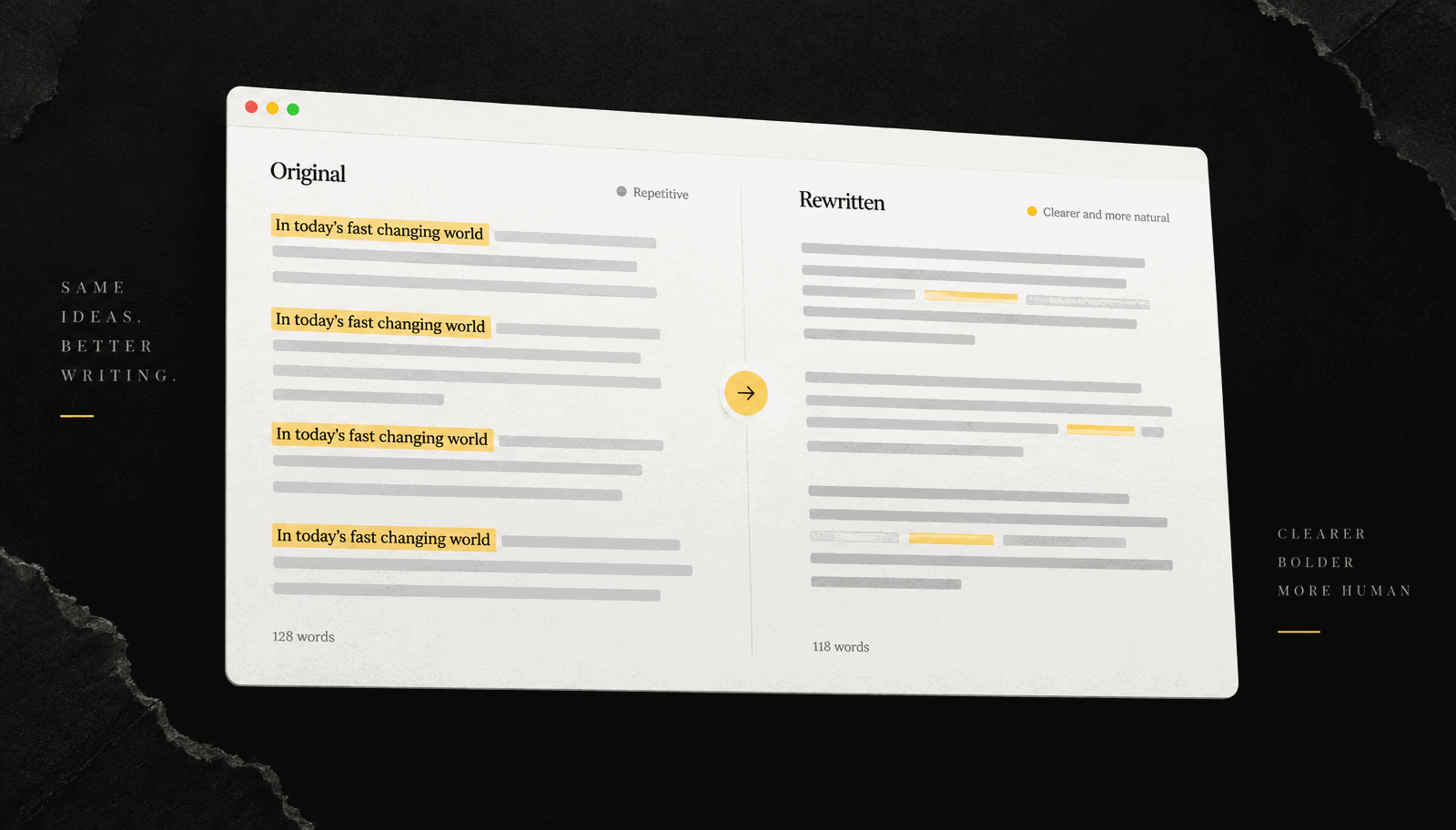
AI-generated writing can be grammatically correct and still feel strangely repetitive.
You may notice the same transition words appearing throughout a paper. Several sentences may begin with the same structure. Every paragraph may follow an almost identical rhythm. Or the draft keeps restating the same point using slightly different words.
The problem is not necessarily that the ideas are bad. The problem is that the writing has become predictable.
The good news is that you usually do not need to rewrite the entire draft. You can fix repetitive AI writing by identifying the patterns that make it feel mechanical, then editing those patterns deliberately.
Here are nine practical edits for AI-assisted writing that keep the original argument and meaning intact.
1. Find words and phrases that appear too often
Start with the simplest problem: repeated vocabulary.
AI writing often leans heavily on the same words throughout a draft, especially when the topic has a small set of obvious terms. A word may be appropriate once or twice but distracting when it appears in every paragraph.
Look for repeated:
- adjectives
- transition words
- sentence openers
- verbs
- phrases such as “it is important to note”
- generic academic expressions
- descriptions of the same idea
Do not automatically replace every repeated word with a synonym.
Sometimes repetition is necessary. If you are writing about climate change, education, or economic growth, the main term will naturally appear many times. The goal is to remove unnecessary repetition, not force every sentence to use a different word.
Example
Technology plays an important role in education. Technology gives students access to more resources. Technology also allows students to communicate more easily.
A cleaner version:
Technology plays an important role in education. It gives students access to more resources and makes communication easier.
The second version removes repetition without making the writing artificially complicated.
A useful test
Ask: “Does this word appear repeatedly because the subject requires it, or because the sentence could have been written more naturally?” That distinction matters.
2. Stop every sentence from following the same pattern
One of the strongest signs of repetitive writing is not vocabulary. It is sentence structure.
AI can help students organize their ideas.
AI can help students improve their grammar.
AI can help students understand difficult concepts.
AI can help students complete tasks more efficiently.
Nothing is grammatically wrong, but the repeated structure makes the paragraph feel mechanical.
You can vary the construction:
AI can help students organize their ideas and improve grammar. It can also make difficult concepts easier to understand. When used appropriately, these tools can make some writing tasks more efficient.
The information has not changed much. The rhythm has.
When revising, deliberately vary:
- sentence length
- sentence openings
- active and passive constructions where appropriate
- simple and compound sentences
- where important information appears in the sentence
You do not need dramatic variation. Small structural changes are often enough.
3. Cut repeated transitions
AI-assisted writing often relies heavily on obvious transitions such as “Furthermore,” “Moreover,” “Additionally,” “In addition,” “Therefore,” “Consequently,” and “On the other hand.” These words are not bad by themselves. The problem starts when every paragraph needs one.
Furthermore, AI can help students save time. Moreover, it can help them organize their work. Additionally, it can improve the clarity of their writing.
This sounds organized, but it also sounds formulaic. Try removing connectors that add no meaning:
AI can help students save time by organizing parts of their workflow. It can also improve the clarity of a draft.
Sometimes the strongest transition is no transition at all. Before keeping a connector, ask whether the reader actually needs it to understand the relationship between the ideas.
4. Combine sentences that repeat the same idea
Another common problem is semantic repetition. The writing may use different words while saying essentially the same thing twice.
AI tools can save students time. These tools can make students’ work more efficient. As a result, students may be able to complete their tasks faster.
A tighter version:
AI tools can make some student workflows more efficient, reducing the time required for repetitive tasks.
First identify the actual idea. Then ask: “What new information does this sentence add?” If the answer is “not much,” it may belong with the sentence before it. This is particularly useful in introductions and conclusions, where AI-generated drafts often restate the thesis several times.
5. Vary paragraph openings
A draft can become repetitive even when individual sentences are fine. Look at the first sentence of every paragraph. Do several begin with “One benefit,” “Another benefit,” or “AI can”?
Instead, give each paragraph a clear opening strategy:
- Problem first: The biggest issue is not usually grammar. It is repetition.
- Evidence first: A useful way to see the problem is to compare the first and second drafts.
- Contrast first: Better vocabulary will not fix a paragraph whose structure never changes.
- Direct explanation: Repetition becomes distracting when the reader can predict the next sentence.
Changing the opening strategy makes the whole article or essay feel less formulaic.
6. Remove filler instead of replacing it with bigger words
When people try to fix repetitive AI writing, they often replace simple language with elaborate language. That can make the writing worse.
It is important to recognize that there are many different ways in which students are able to make improvements to their writing.
A cleaner version:
Students can improve their writing in several ways.
Look for phrases such as:
- it is important to note that
- it should be noted that
- in order to
- due to the fact that
- a wide range of
- in the process of
- it can be seen that
- there are a number of ways in which
Many can simply disappear. Good editing usually means removing unnecessary language, not adding personality to every sentence. Use this clarity checklist for a focused second pass.
7. Check whether the same idea returns at the end of paragraphs
AI writing often follows a point, explanation, and restatement pattern:
Social media can affect concentration. Constant notifications can interrupt students while they are studying. This means that social media can make it harder for students to concentrate.
The third sentence may be unnecessary because the first two already establish the point. After each paragraph, ask whether the final sentence adds a conclusion or implication, or merely repeats what the reader already understood.
8. Fix repetition without destroying your voice
There is an important difference between variation and random synonym swapping.
If you normally write “The results suggest that,” a tool should not force every instance into “The findings indicate that,” “The evidence demonstrates that,” and “The data reveals that.” It may reduce repetition while making the writing feel less natural.
Your normal vocabulary is part of your writing style. Focus on passages where repetition is genuinely distracting. A paper should not sound like it was written by a thesaurus. It should sound clear, consistent, and appropriate for the assignment.
A useful approach is:
- Keep important technical terms.
- Keep words that naturally belong to the subject.
- Remove repeated filler.
- Restructure sentences where the pattern becomes obvious.
- Change vocabulary only when the original word genuinely becomes distracting.
For a deeper voice-focused process, see how to make writing sound like you.
9. Read the draft out loud
This is one of the simplest ways to catch repetition. You may not notice a pattern while reading silently because your brain focuses on meaning. Read the paragraph aloud and repeated openers, sentence lengths, and transitions become easier to hear.
You do not need to read an entire 3,000-word paper aloud. Start with:
- the introduction
- one paragraph from the middle
- the conclusion
- any section that feels unusually repetitive
If a pattern sounds noticeable aloud, it is probably worth revising.
A quick before-and-after example
Repetitive AI-assisted writing:
AI can help students improve their writing. AI can help students improve grammar. AI can also help students improve clarity. Additionally, AI can help students make their writing more effective. Furthermore, AI can help students save time when writing.
The phrase “AI can help students” does almost all of the work. A tighter version:
AI can help students improve grammar, clarity, and overall effectiveness while reducing some of the repetitive work involved in revision.
Academic writing example
Repetitive:
The study is important because it provides useful information. The study is also important because it provides information about student behavior. In addition, the study provides useful information for researchers.
Improved:
The study provides useful evidence about student behavior and gives researchers additional information to work with.
The solution is not fancier words. It is removing duplicated ideas and rebuilding the sentence around the information that matters.
Should you use an AI tool to fix repetitive writing?
Yes, but use it as an editing tool rather than blindly accepting every rewrite. The Bypassify Rewriter supports targeted changes instead of forcing every draft through one generic improvement pass.
- Identify the problem. Is the repetition coming from vocabulary, sentence structure, transitions, or repeated ideas?
- Decide what must stay. Protect your argument, evidence, citations, names, numbers, quotations, and technical terminology.
- Rewrite the section. Ask for a targeted change, such as reducing repetition while preserving meaning and tone.
- Compare it with the original. Make sure the revision did not remove a qualification or alter what you meant.
- Make the final decision yourself. AI can suggest alternatives, but you decide which version represents your meaning and voice.
For higher-stakes papers, follow this guide to rewrite academic text without changing facts.
How Bypassify can help
When the problem is repetitive wording or structure, Bypassify’s Rewriter lets you focus on clarity, flow, tone, concision, or vocabulary and compare the original with the revised version. Its writing workflow is built to preserve quotations, citations, numbers, names, technical terminology, and document structure.
That means you can use it for a specific problem instead of completely replacing your draft:
Original → Rewriter → Compare → Keep or edit
The comparison step matters. A good rewrite is not one that looks completely different. It is one that solves the problem you actually had.
A 60-second checklist for repetitive AI writing
Vocabulary
- Am I repeating the same non-essential words?
- Am I using synonyms unnecessarily just to avoid repetition?
Structure
- Do several sentences start the same way?
- Are my sentences all roughly the same length?
Transitions
- Am I using ‘Furthermore,’ ‘Moreover,’ or ‘Additionally’ too often?
- Does each transition actually help?
Ideas
- Does each sentence add something new?
- Am I restating the same conclusion at the end of every paragraph?
Voice
- Does the writing still sound consistent with the rest of my work?
- Have I replaced normal words with unnatural synonyms?
Accuracy
- Did any rewrite change a fact, number, citation, quotation, qualification, or technical term?
If you can answer these questions confidently, your draft will usually feel much less repetitive without needing a complete rewrite.
Frequently asked questions
What makes AI writing sound repetitive?
AI writing can sound repetitive when it repeatedly uses the same vocabulary, sentence structures, transitions, paragraph patterns, or ideas. The problem is often structural rather than grammatical.
How do I make AI writing less repetitive?
Start by identifying unnecessary repeated words and phrases, then vary sentence structures, remove redundant transitions, combine overlapping ideas, and cut filler. Keep important terminology instead of replacing every repeated word with a synonym.
How do I fix repetitive ChatGPT writing without changing the meaning?
Identify the main claim and any facts, numbers, citations, quotations, or qualifications that must remain unchanged. Then restructure sentences, remove repetition, and compare the revised version with the original before using it.
Should I use synonyms to fix repetitive AI writing?
Sometimes, but not automatically. Excessive synonym swapping can make writing unnatural or change the intended meaning. It is usually better to fix the sentence structure or remove duplicated ideas first.
Can an AI rewriter help with repetitive writing?
Yes. An AI rewriter can suggest alternative sentence structures, improve flow, reduce redundancy, and adjust vocabulary. Review the output against the original so the meaning, evidence, and intended tone remain correct.
Final takeaway
Fixing repetitive AI writing is usually an editing problem, not a vocabulary problem.
Start by identifying the pattern: repeated words, repeated sentence structures, repeated transitions, or repeated ideas. Then fix the actual source. Cut filler. Combine overlapping sentences. Vary sentence structure. Remove unnecessary transitions. Keep important terminology. Protect your evidence. Always compare an AI-assisted rewrite with the original before using it.
The goal is not to make writing look artificially different. It is to make the writing clearer, more purposeful, and easier to read while keeping the ideas that matter.
Sources and further reading
Write it once. Let Bypassify keep it human.
The free browser extension humanizes or rewrites whatever you select, in any tab, using your own Writing DNA.