
Fix the 5 Dead Giveaways of a ChatGPT Cover Letter
Learn how to spot and fix the five dead giveaways of a ChatGPT cover letter, from robotic openings to vague praise, before you hit send.
Have a draft to refine? Try the Humanizer free, citations kept intact. No card needed.
Start free →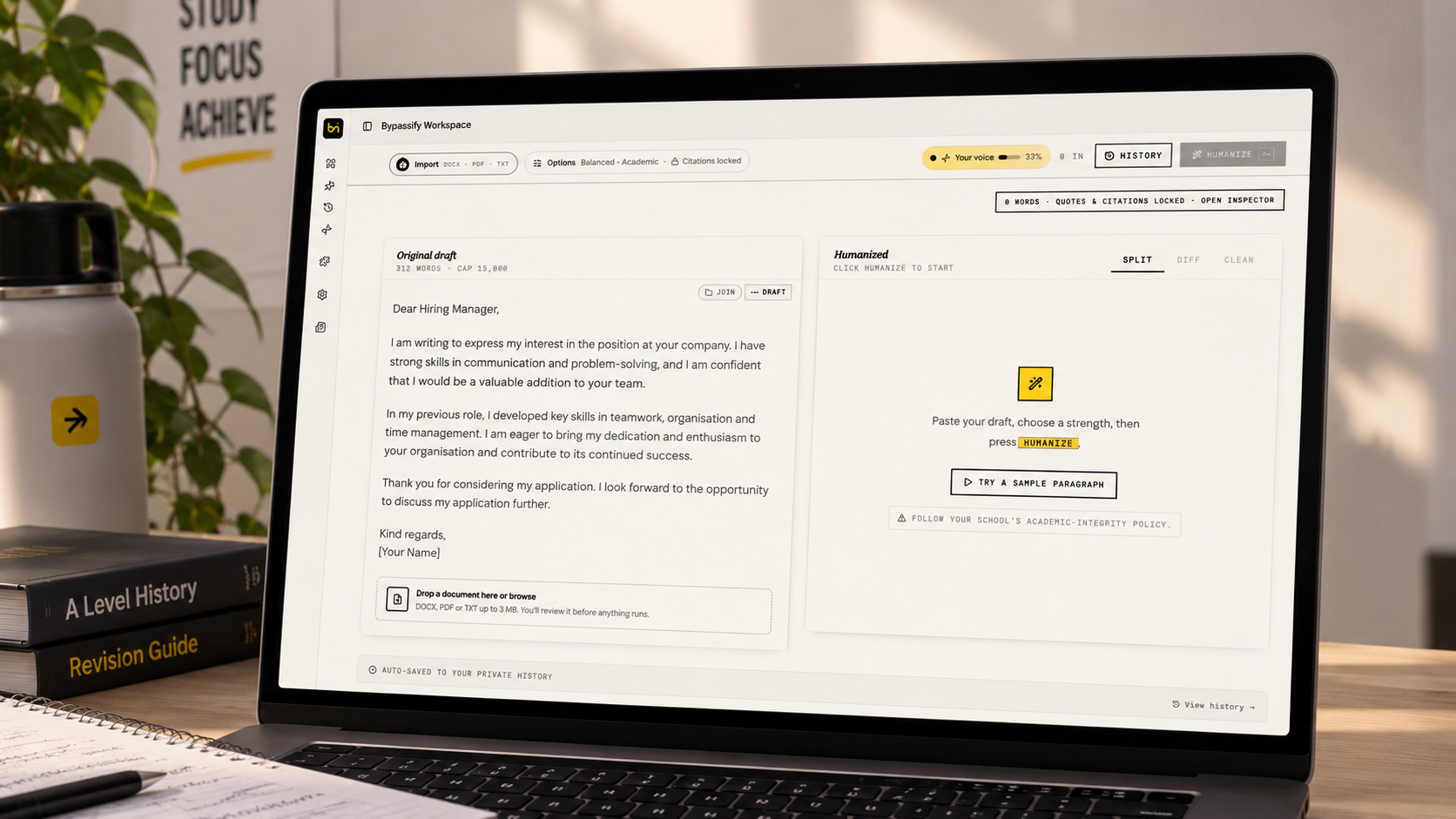
Hiring managers read hundreds of applications, and right now, many of those applications sound identical.
When language models draft a cover letter, they fall into familiar patterns. The sentences are mechanically balanced, the compliments are lavish yet empty, and the enthusiasm feels artificial. While using artificial intelligence to brainstorm or organize your thoughts makes sense, submitting a raw draft hurts your chances.
Recruiters do not necessarily disqualify you because you used an AI tool. They disqualify you because the resulting letter is boring, vague, and conveys zero personal credibility. If you want your application to stand out, you need to identify and remove the five dead giveaways that signal an unedited ChatGPT draft.
1. The Theatrical Opening Formula
Ask any language model to write an application letter, and it will almost certainly open with the same stiff formulation. It declares an overwhelming passion for the position before you have even introduced who you are.
- The Giveaway: "I am writing to express my enthusiastic interest in the Marketing Associate position at your esteemed organization."
- Why it fails: Real people do not talk like eighteenth-century courtiers. Phrases like "enthusiastic interest" and "esteemed organization" are filler. They take up valuable space on the page without giving the reader a single fact about your qualifications.
To fix this, cut straight to the point. State the role, mention how you found it or who referred you, and summarize your core background in one confident sentence.
- The Fix: "I am applying for the Marketing Associate role. Over the last two years at North River Media, I managed our weekly newsletter and grew subscriber engagement by 35 percent."
2. Empty Buzzword Stacking
AI models rely heavily on corporate jargon to bridge gaps when they lack specific context. Instead of describing actual work, they string together high-sounding nouns and verbs that say nothing.
Watch out for clusters like "fostering collaborative synergy," "driving innovative paradigms," or "spearheading multifaceted initiatives." When a recruiter reads these phrases, they learn that you can string syllables together, but they still have no idea what you did on a Tuesday morning at your last job.
- The Giveaway: "In my previous role, I served as a dynamic team player, leveraging cross-functional capabilities to optimize client engagement and deliver robust results."
- The Fix: "In my previous role, I worked directly with our sales and product teams to update our onboarding guides, cutting support tickets by 18 percent in three months."
If you find yourself stuck with paragraphs that feel dense and artificial, running the draft through the Bypassify Rewriter can help strip out inflated vocabulary and restore clear, direct sentence structures.
3. Symmetrical, Predictable Sentence Rhythm
Language models love parallel structure. They often construct sentences using a relentless "Not only X, but also Y" pattern, or they follow every verb with three neatly balanced clauses.
Notice how this sounds when repeated across several paragraphs:
- "Not only did I manage daily administrative tasks, but I also improved team communication."
- "I was responsible for analyzing consumer data, identifying market trends, and presenting findings to leadership."
- "Through hard work, careful planning, and clear communication, I met every quarterly target."
When every sentence has the same length, cadence, and tripartite division, the reading experience becomes monotonous. Human speech has texture. Some sentences are punchy and short. Others carry a complete thought through two dependent clauses, followed by a crisp conclusion.
Break up the rhythm manually. Mix short statements with longer explanatory sentences. Read your writing out loud. If your voice falls into an identical singsong cadence in every paragraph, rework the sentence boundaries.
4. Generic Corporate Flattery
ChatGPT often tries to prove that you care about the employer by inserting hollow, generic compliments. Because the model knows the company is a business, but does not know your personal connection to it, it invents general praise.
- The Giveaway: "I have long admired your company's visionary approach to customer satisfaction and your commitment to pushing the boundaries of excellence."
- Why it fails: You could paste that exact sentence into an application for a retail bank, a software startup, or a plumbing supply distributor, and it would apply equally to all three. Recruiters spot this instantly because it shows you did not research the company.
Replace generalized adoration with a concrete observation. Mention a specific product update, an interview given by the founders, or a practical problem the company solves that interests you.
- The Fix: "I followed your team's launch of the open-source analytics toolkit last November. The focus on local data storage addresses a major gap in the market, and it is the primary reason I wanted to apply to this team."
5. The Grandiose Conclusion
Just as AI letters open with excessive ceremony, they close with high-flown summaries that resemble the end of a high school persuasive essay. Look out for closing lines that declare you are "the ideal candidate" who will "undoubtedly make an immediate and lasting contribution to your team."
Confidence is valuable, but unearned arrogance derived from an automated template falls flat. You do not know who else applied, and making sweeping declarations about how perfect you are sounds naive.
Instead, close with professionalism, practical availability, and courtesy.
- The Giveaway: "In conclusion, I am confident that my unique blend of passion, dedication, and expertise makes me the optimal fit to elevate your organization to new heights."
- The Fix: "I have attached my resume and sample portfolio below. I would welcome the opportunity to discuss how my background in content production fits your plans for the upcoming quarter."
If your draft still feels stiff after adjusting these sections, running it through the Bypassify Humanizer helps eliminate lingering machine cadences while preserving your resume details and qualifications.
Your Pre-Submission Checklist
Before you attach your PDF and hit submit, run through this quick review to catch any remaining automated habits:
- Delete robotic transition words: Cut words like "Furthermore," "Moreover," "Additionally," and "In summary" from the beginning of paragraphs.
- Add at least three specific nouns: Make sure you name real tools, actual software, or specific project outcomes that only apply to your career.
- Check the first five words: Ensure the letter starts with who you are or what you do, rather than a proclamation of your deep enthusiasm.
- Vary sentence length: Make sure you have at least one sentence under eight words and no run-on sentences over thirty words.
- Audit adjectives: Remove decorative qualifiers like "deep," "unwavering," "pivotal," and "transformative."
What to Do Next
Open your current cover letter draft right now and read only the first sentence and the final sentence. If either sounds like a formal speech rather than a conversation with a future colleague, delete it and write a direct, plain statement in its place.
Frequently asked questions
Can hiring managers really tell if a cover letter was written by ChatGPT?
Yes, experienced hiring managers review dozens of applications every week and recognize the default tone quickly. ChatGPT relies on predictable phrases, symmetrical clauses, and hollow flattery that stand out immediately. While it rarely makes grammatical errors, the lack of genuine personal voice is an obvious tell.
Is it bad to use ChatGPT to help write a cover letter?
Using AI as a brainstorming partner or structural guide is completely reasonable. The mistake is submitting unedited text that repeats robotic tropes and generic claims. You should always treat an AI draft as raw material that needs your personal anecdotes, tone, and specific details.
What is the single biggest giveaway of an AI cover letter?
The opening sentence is almost always the dead giveaway. AI models usually produce theatrical, stiff openings like 'I am writing to express my enthusiastic interest in the position.' Real professionals speak directly, state the role, and lead with a concrete achievement or shared connection.
How can I make my cover letter sound more human without starting from scratch?
Start by deleting empty adjectives and replacing broad claims with specific metrics or project names. Read your sentences out loud, and if a phrase sounds unnatural to say to a colleague in person, rewrite it. Using a dedicated tool to review flow and tone can also smooth out awkward machine habits.
Do I need to submit a cover letter if the job post says it is optional?
If the application gives you the option, submitting a tailored, genuine cover letter helps you stand out from candidates who skip it or send generic templates. A concise, well edited three-paragraph letter shows initiative and allows you to explain context that your resume cannot capture.
Ready to fix your own draft?
Paste a paragraph and see the result in seconds. Quotes and citations stay exactly as you wrote them, and your drafts stay private.
- 5 free runs a day
- No card needed
- Citations kept