
Do Teachers Check A Level Coursework for AI?
Learn how UK schools and exam boards review A Level coursework for AI use, what teachers actually look for, and how to keep your drafting authentic.
In conclusion, this week's reading delves into the multifaceted landscape of climate policy, highlighting the pivotal importance of international cooperation.
This week's reading made one point clear to me: climate policy only works when countries actually cooperate.
- Generic AI phrasing replaced
- Sounds like a person
- Main point unchanged
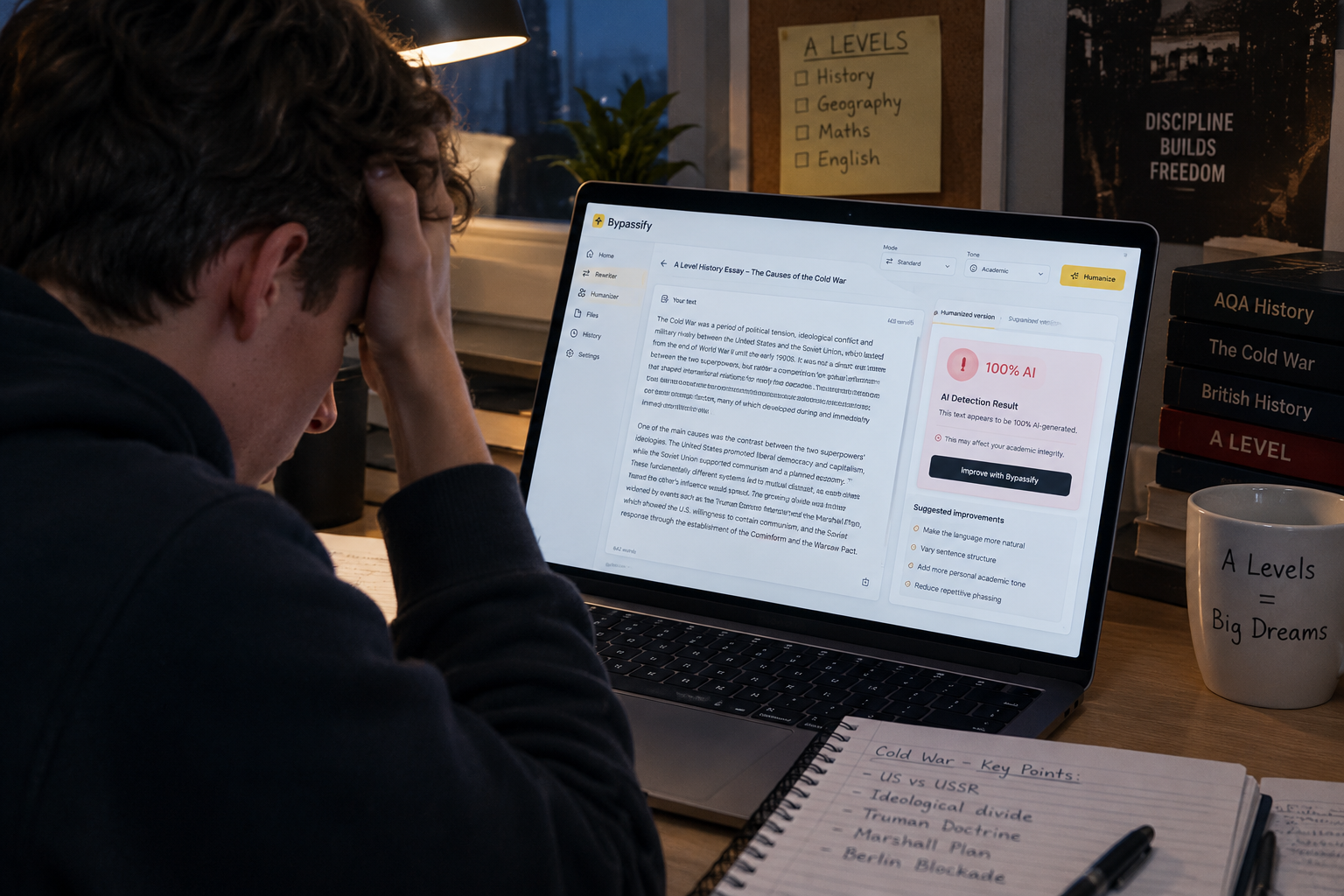
If you are finishing an A Level in English, History, Geography, or Media Studies, coursework counts for a significant share of your final grade. With that weight comes a sharp spike in anxiety. You might wonder whether your teacher runs your essays through automated checkers, what exam boards like AQA, Edexcel, and OCR actually look like for, and whether innocent drafting could trigger an awkward conversation.
Understanding how teachers evaluate non-exam assessment helps take the panic out of the submission process. Here is what happens behind the staff room door, how schools handle AI concerns, and how you can protect your own voice.
What UK Schools and Exam Boards Actually Look For
The Joint Council for Qualifications (JCQ) sets the rules across England, Wales, and Northern Ireland. JCQ guidelines state clearly that students must submit work that reflects their own independent knowledge, synthesis, and writing. When teachers sign the candidate authentication form, they legally confirm that, to the best of their knowledge, the work is yours.
Teachers do not usually sit down with the sole goal of catching you out with an automated tool. Instead, they read your work against a benchmark they already know well: your authentic classroom voice.
The Red Flags Teachers Notice First
Automated detection tools produce high rates of false positives, which experienced teachers know. Because of this, schools pay much more attention to human signs of artificial text than a single software score.
- Sudden vocabulary shifts: If your timed essays in class read at a steady grade B level, but your coursework opens with unusual, florid adjectives and hyper-academic vocabulary, teachers pause.
- Vague historical or literary context: Large language models often write plausible sounding sentences that lack precise historical dates, secondary critic quotes, or specific page references from your set texts.
- Invented sources and hallucinated citations: When an essay cites a critical essay that does not exist or attributes a quotation to the wrong chapter, it is an instant warning sign.
- Homogeneous structure: AI generated writing leans heavily on formulaic paragraph transitions, repetitive three-item lists, and summaries that conclude by repeating the introduction.
The Difference Between Research Support and Misconduct
Using digital tools during your planning stage is common. You might use software to help organize research ideas, check punctuation, or clarify difficult critical theories. The problem arises when software replaces your personal analysis.
A Level mark schemes reward critical evaluation, original line of argument, and close reference to data or text. When students rely on software to draft whole paragraphs, those paragraphs lose the messy, granular detail that examiners look for to award top bands.
If you use tools to polish your own drafts, clarity matters. Services like the Bypassify Rewriter can assist by straightening out awkward syntax or passive sentences, but the core ideas, specific evidence, and interpretive links must come directly from your own reading.
Why AI Detection Scores Cause Stress
Many sixth-form colleges run coursework drafts through Turnitin or similar platforms. Seeing an arbitrary percentage score attached to a piece of work you spent weeks writing can be terrifying.
Automated detectors work by predicting how likely a word is to follow the previous word. Because academic writing follows formal conventions, disciplined academic English naturally shares patterns with computer models. A tightly structured paragraph analyzing the Treaty of Versailles can easily trip an automated detector simply because it uses expected academic phrasing.
For this reason, exam boards instruct schools never to issue penalties based purely on a detector score. An automated flag is simply an invitation for your teacher to look closer, not proof of guilt.
What to Do If Your Teacher Asks About Your Text
If a teacher calls you aside to ask about a specific paragraph or chapter in your coursework, do not panic. Treat it as an academic conversation rather than an accusation.
1. Show Your Document Version History
If you write in Google Docs or Microsoft Word online, your version history tracks every keystroke over weeks. A student who writes their own essay has hours of incremental changes, deletions, rephrased sentences, and structural rearrangements. A pasted chunk of machine text appears out of nowhere in two minutes. Your revision history is your strongest piece of evidence.
2. Walk Through Your Sources
Bring your physical books, digital PDFs, library notes, and annotated printouts. If you can open the novel or textbook and point directly to where you found a quotation, you show immediate command over the subject matter.
3. Talk Through Your Ideas Out Loud
Teachers know how you talk. When you explain your thesis in your own words, outline why you disagree with a particular critic, or explain why you chose a specific research method for your geography field study, the teacher sees that the intellect behind the page matches the student in the chair.
Keeping Your Coursework Sound and Natural
When revising your drafts, the goal is always to make your real voice easier to understand, not to hide behind complex phrasing. Many students write stiff, overly formal sentences because they think that is what an A Level examiner expects. In reality, examiners prefer crisp, direct prose.
Here is an example of over-complicated drafting versus clean, natural student prose:
- Before: It can be convincingly posited that the multifaceted socio-economic developments in Weimar Germany inevitably served to foster systemic instability across the domestic sphere.
- After: Economic distress and hyperinflation destabilized the Weimar government, leaving ordinary citizens increasingly skeptical of democratic leadership.
The second sentence is clearer, stronger, and sounds like an engaged student rather than an encyclopedia summary. If you find your drafts sounding generic or synthetic after editing, the Bypassify Humanizer helps restore natural cadence while preserving your facts, dates, and direct quotations intact.
Pre-Submission Coursework Checklist
Run through this quick list before you print your final copy or upload it to your school portal:
- Keep an offline backup of your initial outline, rough notes, and intermediate drafts.
- Verify every quotation against the original text, including page numbers and line references.
- Check your bibliography entries to ensure every listed critic or study exists in real life.
- Read your essay aloud to check for robotic transitions or sentences that say very little.
- Ensure you have signed and dated your candidate authentication declaration truthfully.
The Next Step for Your Draft
Take fifteen minutes today to sit down with a printed copy of your current coursework draft and a pen. Read your analysis out loud to yourself. Cross out any sentences that sound vague, empty, or unlike you, and rewrite them using simple, decisive explanations backed by your own evidence.
Frequently asked questions
Do teachers use AI detectors on A Level coursework?
Many schools use platforms like Turnitin or basic detector software to scan submissions. However, teachers rely primarily on their familiarity with your regular writing style, class discussions, and draft history rather than trusting detection scores alone.
What happens if a teacher suspects AI in my coursework?
Your teacher will typically discuss the work with you first. They may ask you to explain specific arguments, define complex terminology you used, or show your earlier drafts, research notes, and browser history to confirm authorship.
Does JCQ allow any AI use in A Level coursework?
The Joint Council for Qualifications permits AI for background research or brainstorming if permitted by your subject specification, but all final analysis and prose must be your own. Any direct AI assistance or text must be explicitly acknowledged.
Can false positives happen on A Level essays?
Yes, automated detectors often flag formal, analytical student writing as AI generated due to conventional sentence structures. This is why exam boards instruct teachers not to rely solely on automated percentages to make academic misconduct allegations.
How can I prove my A Level coursework is genuinely mine?
Keep detailed version histories in Google Docs or Word, maintain messy handwritten or typed research notes, and keep records of all primary sources you consulted. If questioned, walking your teacher through your drafting timeline clears up any doubts immediately.
Ready to fix your own draft?
Paste a paragraph and see the result in seconds. Quotes and citations stay exactly as you wrote them, and your drafts stay private.
- 5 free runs a day
- No card needed
- Citations kept