
Do Exam Boards Check Your IGCSE Coursework for AI?
Learn how exam boards review IGCSE coursework for AI generation, what markers look for, and how to use editing tools responsibly before submission.
In conclusion, this week's reading delves into the multifaceted landscape of climate policy, highlighting the pivotal importance of international cooperation.
This week's reading made one point clear to me: climate policy only works when countries actually cooperate.
- Generic AI phrasing replaced
- Sounds like a person
- Main point unchanged
How Exam Boards Approach AI in IGCSE Coursework
If you are finishing coursework for Cambridge (CAIE), Pearson Edexcel, or Oxford AQA, you probably want to know whether an automated tool will scan your submission for artificial intelligence. The short answer is yes, but not in the way many students assume.
Exam boards do not simply paste your essay into a single detector and issue a disqualification based on an arbitrary percentage score. Instead, they treat AI generation under their longstanding malpractice frameworks. Major boards issue regular guidance to centers and teachers stating that uncredited AI content counts as plagiarism. While exam boards have access to automated detection platforms, the real check begins much closer to home: with your own subject teachers and school moderators.
Schools are legally required to sign an authentication statement confirming that the work you submit is your own independent effort. If your teacher notices an abrupt shift in your vocabulary, syntax, or subject mastery, they will investigate before your coursework ever reaches the external examiner.
What Teachers and Examiners Actually Look For
Automated AI detectors are notoriously inconsistent, producing both false positives and false negatives. Because boards know this, examiners look for specific qualitative clues that point to machine generation rather than student thought.
Sudden Shifts in Vocabulary and Style
Your teacher knows how you write. They have marked your homework, watched you answer questions in class, and read your timed mock exams. If your typical writing uses concise, straightforward sentences, and your final coursework suddenly features dense, overly ornate phrasing, teachers will notice immediately.
AI models frequently rely on predictable transitional devices and balanced sentence structures that rarely appear in natural teenage writing. When an examiner spots these stylistic markers alongside advanced vocabulary that the student cannot define in person, they flag the paper.
Phantom Sources and Generic Explanations
Language models often invent citations, misquote literary texts, or reference historical events that never happened. In IGCSE subjects like History, English Literature, or Global Perspectives, examiners are subject specialists who know primary sources thoroughly. A single invented quotation or fabricated study will immediately trigger a malpractice inquiry.
Even when AI models do not hallucinate facts, they tend to write in broad generalities. High scoring IGCSE coursework requires precise local case studies, primary data collection, and specific textual analysis. Generic paragraphs are an immediate warning sign.
Lack of Genuine Rough Work
When exam boards suspect foul play, the first thing they ask for is evidence of the drafting process. Genuine coursework leaves a clear footprint: messy brainstorms, early drafts with teacher feedback, interview transcripts, and version histories in Google Docs or Word. If a student produces a finished, highly polished paper overnight with no documented revision trail, schools cannot sign the declaration of authenticity.
The Proper Role of AI Tools in Your Study Routine
Using digital assistance is not entirely forbidden, but you must know where helpful research ends and academic misconduct begins. Most exam boards allow students to use technology to improve their understanding, provided the final words and conclusions belong to the student.
Here is how you can use digital tools without crossing ethical boundaries:
- Clarifying complex source material: Ask a tool to explain a dense academic paper or historical document in simpler terms so you understand the concepts.
- Brainstorming starting angles: Generate a list of broad themes or exploratory questions to kickstart your own planning.
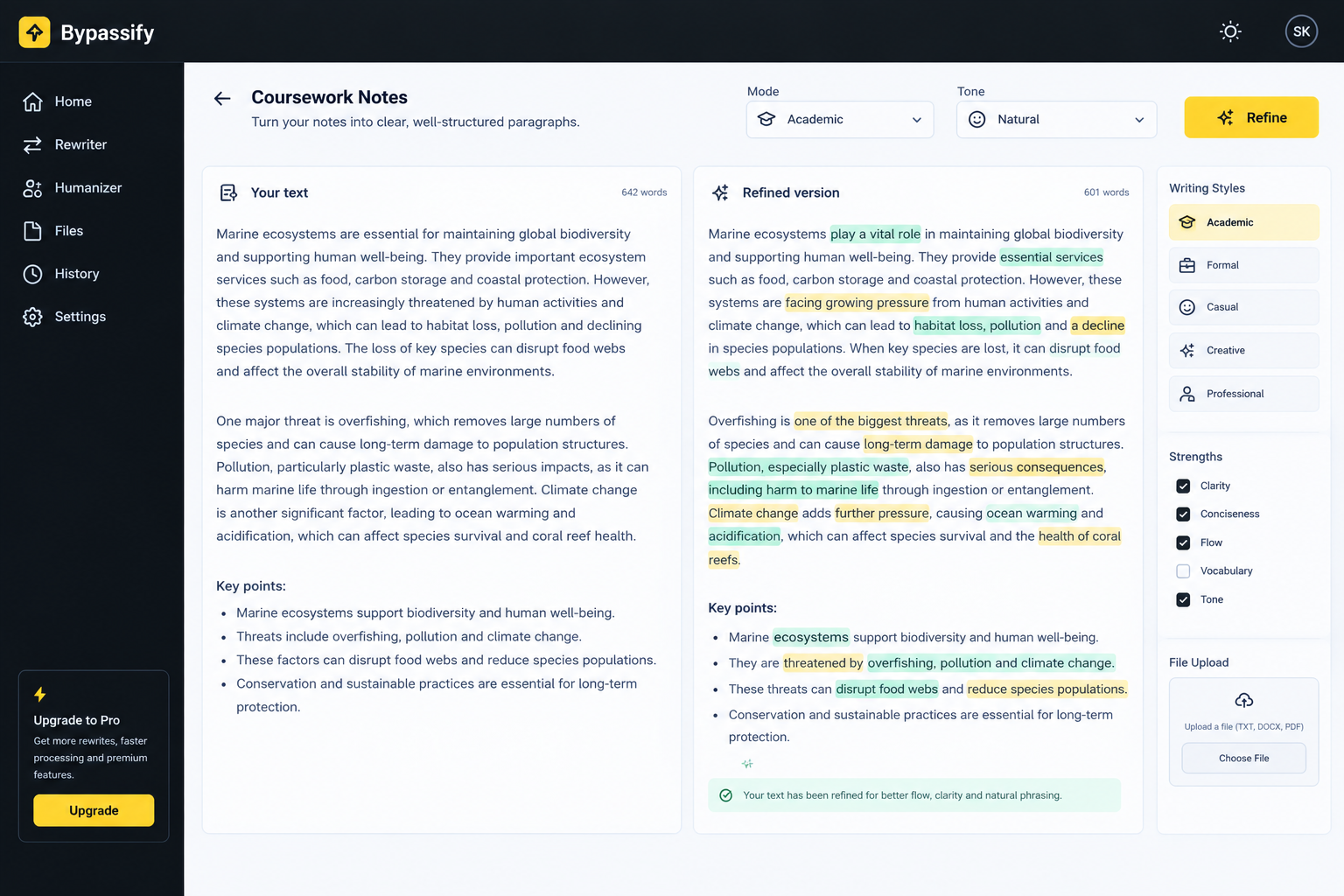
- Refining your own rough drafts: Use the Bypassify Rewriter to spot clunky grammar, fix repetitive phrasing, and clarify your arguments after you have written your own initial text.
- Checking tone: If your drafts read too stiffly or mechanically, you can use the Bypassify Humanizer as an editing aid to make your phrasing feel natural, clear, and focused.
If you want to understand the technology behind these editing workflows, reviewing how Bypassify works will show you how clarity engines rephrase passages without changing your core evidence or meaning.
Comparing Problematic AI Writing with Authentic Student Work
To see what examiners pick up on, look at how an automated draft differs from an authentic student paragraph.
The Machine Draft
The play Macbeth serves as an intricate examination of the destructive nature of unchecked ambition. Shakespeare masterfully employs a plethora of symbolic elements, such as blood and sleep, to illuminate the psychological disintegration of the titular protagonist. Furthermore, this dynamic highlights universal truths about human morality across diverse cultural contexts.
This paragraph sounds sophisticated on the surface, but it says almost nothing specific. Words like "plethora" and "intricate examination" read like generic filler, and the final sentence is an empty platitude.
The Student Draft
In Act 2, Shakespeare uses blood to show Macbeth's immediate guilt after killing Duncan. When Macbeth looks at his hands and asks if Neptune's ocean could wash them clean, his language changes from confident to terrified. This contrasts sharply with Lady Macbeth's practical reaction in the same scene, showing that his guilt is psychological rather than physical.
This second version is direct, focused on specific textual evidence, and clearly written by someone engaging with the play. Examiners reward this kind of concrete analysis over vague, elevated prose.
Pre-Submission Verification Checklist
Before you hand in your final IGCSE coursework folder, run through these essential checks:
- Keep your version history intact: Do not write your coursework in an external chat window and paste it into a blank document. Write directly inside your document editor so every edit is recorded.
- Verify every quotation and citation: Check every page number, date, and author against physical books or verified online archives.
- Read your work out loud: If you stumble across a word you do not use in regular conversation, replace it with a clearer, more familiar term.
- Check syllabus regulations: Read the specific course guidelines for your exam board to confirm whether you need to cite software assistance in your bibliography.
- Prepare to explain your work: Make sure you can comfortably discuss your methodology, findings, and arguments with your teacher without looking at your notes.
What to Do Next
Take the draft you have written and read through each section with an editor's eye. Cut out vague generalities, ensure every source is accurate, and replace inflated phrasing with direct, honest analysis that reflects your own voice.
Frequently asked questions
Do exam boards use automated AI detectors on IGCSE coursework?
Exam boards have access to commercial detection software, but they rarely rely on automated scores alone. Instead, boards use software as an initial flag alongside teacher reviews and historical student work. A human examiner always investigates suspicious flags before making any formal decision.
Can my school report me to the exam board for using AI?
Yes. Your school must authenticate that the work you submit is entirely your own. If a teacher suspects you submitted AI generated text without permission, the school can open an internal malpractice investigation or report the case directly to the board.
Am I allowed to use AI to help research my IGCSE project?
Most exam boards permit AI for initial brainstorming, finding background reading, or clarifying difficult concepts, provided your school allows it. However, you must write the final text yourself and declare any significant assistance according to your syllabus guidelines.
What happens if an exam board finds AI in my coursework?
Penalties depend on the severity of the offense. Minor infractions might result in losing marks for the affected section, while severe cases can lead to disqualification from the component, the entire syllabus, or all exams across that exam series.
How can I prove my IGCSE coursework is my own writing?
Keep your rough notes, initial outlines, and draft versions in your word processor with version history enabled. If an examiner questions your phrasing, you can present these revision logs and explain your research decisions clearly during a review.
Ready to fix your own draft?
Paste a paragraph and see the result in seconds. Quotes and citations stay exactly as you wrote them, and your drafts stay private.
- 5 free runs a day
- No card needed
- Citations kept