
Do Colleges Use GPTZero? How Universities Check Essays
Learn whether colleges use GPTZero to scan student essays, how professors evaluate suspected AI text, and how to protect your authentic academic work.
Have a draft to refine? Try the Humanizer free, citations kept intact. No card needed.
Start free →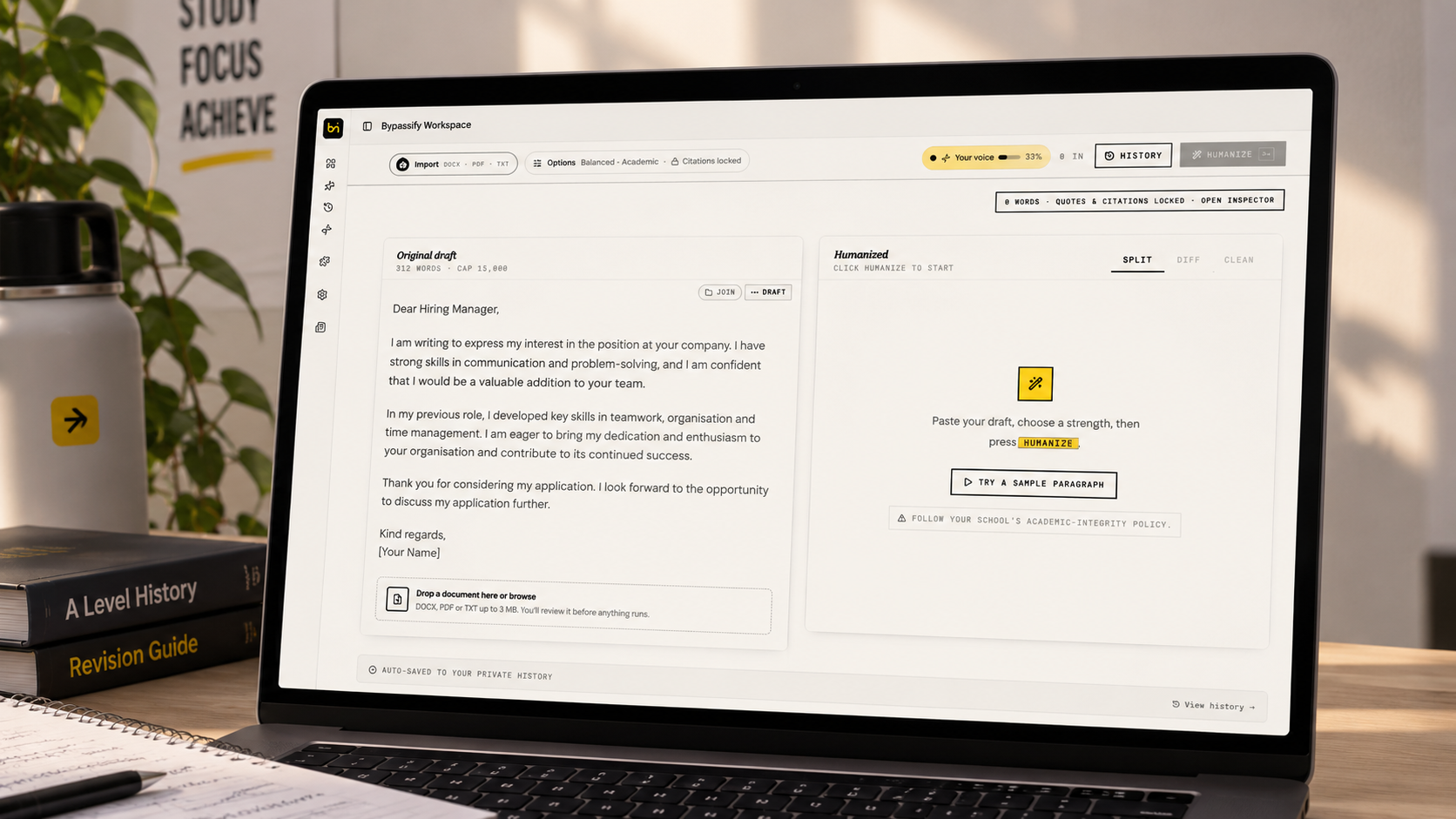
If you are working on college coursework, you have probably wondered what happens when you click submit. With artificial intelligence tools now common for brainstorming and outlining, students frequently ask: do colleges use GPTZero to inspect student work?
The short answer is yes, but rarely in the way students fear. While some individual instructors and departments use GPTZero, universities almost never treat a detector score as an open and shut verdict. Understanding how institutions evaluate student writing helps you use digital tools responsibly without risking your academic standing.
How Colleges Actually Approach GPTZero
When universities adopted policies regarding generative text, administrators quickly realized that detection software is not foolproof. As a result, institutional adoption of standalone tools like GPTZero varies widely across campuses.
Institutional Licenses vs. Individual Instructors
Some universities have purchased site licenses for GPTZero or integrated its API into campus systems. However, widespread adoption of third party checkers remains limited. Most institutions prefer centralized platforms that integrate directly into their learning management systems, such as Turnitin's AI writing indicator inside Canvas or Blackboard.
Where GPTZero appears most often is at the individual instructor level. A professor who notices an unusual shift in tone, vocabulary that seems out of character, or fabricated citations might copy a suspicious passage into GPTZero to see if the statistical metrics warrant a closer look.
Official University Guidance
Many university teaching centers and academic integrity boards publish strict guidelines on detector use. A common standard across major research universities advises instructors never to penalize a student based solely on a software score. Detection platforms measure statistical probability, not concrete facts. Because these tools cannot provide definitive proof, universities treat detector outputs as investigative leads rather than decisive evidence.
Why Universities Do Not Rely on AI Scores Alone
Detectors like GPTZero work by measuring two primary metrics: perplexity and burstiness. Perplexity measures how predictable words are in sequence, while burstiness measures variations in sentence length and structure. AI models generate text that is statistically consistent, meaning low perplexity and low burstiness.
The fundamental problem in higher education is that good academic prose often shares these exact qualities. When you write a formal literature review or a scientific methodology, you use standardized vocabulary, passive constructions, and measured syntax. This creates a high risk of false positives.
Research and institutional audits have highlighted two major vulnerabilities:
- Non-native English speakers: International students and English language learners often rely on formal sentence structures and limited idiomatic variation, causing detectors to mislabel their authentic work as machine generated.
- Formulaic assignments: Lab reports, standard five paragraph essays, and legal briefs follow rigid structural rules that inherently mimic the uniformity of AI generation.
Because of these known blind spots, academic integrity committees require human review, contextual evidence, and an opportunity for the student to explain their drafting process.
What Triggers an Academic Integrity Investigation?
Professors rarely flag papers because an automated tool told them to. In practice, suspicion starts with the reading experience itself. Experienced instructors grade dozens of papers per term and quickly identify when a submission deviates from normal student writing.
Common warning signs include:
- Hallucinated or dead citations: Large language models frequently invent authors, combine real paper titles with fake journal volumes, or link to non-existent URLs. This is often the primary reason an instructor verifies sources.
- Stylistic whiplash: If your discussion board posts use casual sentence fragments and your term paper suddenly reads like an encyclopedia entry, the sudden leap in syntax raises questions.
- Prompt leakage and generic padding: AI drafts frequently include throat clearing phrases, repetitive summaries, and surface level generalizations that fail to engage with specific lecture materials or assigned readings.
When an instructor notices these red flags, they may run the text through GPTZero or Turnitin to corroborate their intuition before contacting the student.
How to Maintain a Clear Audit Trail
The most effective defense against false accusations is a verifiable drafting trail. If you document your writing process from start to finish, an automated score cannot undermine your credibility.
Always draft your papers in a cloud based editor such as Google Docs or Microsoft Word with version history enabled. These platforms automatically save timestamped snapshots as you type, delete, rephrase, and organize paragraphs. A document that shows hours of gradual development, pauses, typos, and revisions provides undeniable proof of human authorship.
Additionally, keep your rough notes, article PDFs, and initial outlines in a single folder until your final grade is posted. If an instructor asks about a specific paragraph, you can easily pull up the original source you summarized and the handwritten or typed notes you used to build your argument.
Polishing AI Assisted Drafts Responsibly
Many students use digital tools to help organize their thoughts, generate outlines, or check grammar. Problems arise when raw, machine generated drafts are handed in without meaningful human intervention. Machine output often sounds rigid, overly formal, and unnatural.
When editing your work, focus on active rewriting rather than passive acceptance of suggestions. Read your sentences aloud to check if they sound like your natural speaking and thinking voice. Cut out empty introductory clauses, vary your sentence lengths, and ensure your own analysis drives every paragraph.
If you find that an outline or early draft has left you with stiff, awkward sentences, you can use the Bypassify Rewriter to improve clarity, flow, and sentence variety while keeping your original arguments and citations intact. When working with early drafts that feel synthetic, running passages through the Bypassify Humanizer helps reshape robotic phrasing into natural prose while preserving your factual meaning and academic tone.
Consider this example of an overly synthetic paragraph compared to a focused, human edit:
- Before: "It is of paramount importance to consider that renewable energy initiatives leverage economic benefits across various sectors of the municipal landscape."
- After: "City leaders invest in renewable energy because lower operating costs create measurable savings for local public transit and municipal utilities."
The revised version removes generic padding, adds concrete detail, and communicates the core idea with direct, natural grammar.
Your Pre Submission Editing Checklist
Before you upload any major college paper, run through this brief quality check:
- Verify all citations: Check that every quoted and paraphrased source exists, points to the correct page or DOI, and directly supports your claim.
- Confirm version history: Ensure your document has a clear, continuous log of edits, additions, and revisions in your word processor.
- Remove stock phrases: Strip out generic transitional words like "delve", "testament to", "in conclusion", and "a tapestry of".
- Tie claims to course material: Ground your paragraphs in specific texts, lecture examples, and datasets covered in your syllabus.
- Read aloud for sentence flow: Mix short, punchy statements with longer explanatory sentences to keep the rhythm natural.
What to Do Next
Open the assignment you are currently working on and check its version history in Google Docs or Word right now. Confirm that auto saving is active, keep your research tabs bookmarked, and spend thirty minutes refining your draft into your own direct, confident voice.
Frequently asked questions
Can a university fail me based solely on a GPTZero score?
Most universities explicitly prohibit instructors from failing students based on an AI detector score alone. Detection tools produce false positives, particularly for structured academic prose and non-native English speakers. An instructor usually needs corroborating evidence, such as missing revision history or an inability to explain the text, before filing an academic integrity violation.
Do professors run every single paper through GPTZero?
No, most professors do not manually upload every assignment to GPTZero. While some departments purchase institutional licenses, instructors are more likely to use built-in detection features inside learning platforms like Turnitin or Canvas. GPTZero is often used as a secondary check when an instructor already suspects a paper feels off.
Does Turnitin use GPTZero for its AI detection?
Turnitin uses its own proprietary AI writing detection model, which is distinct from GPTZero. Both platforms analyze statistical patterns like perplexity and burstiness, but their training data and scoring thresholds differ. A paper flagged by one tool will not necessarily trigger the same result on the other.
Why does GPTZero flag human writing as AI?
GPTZero evaluates text based on predictability and sentence variation. Academic writing naturally follows formal conventions, passive structures, and consistent rhythms, which can closely resemble the statistical output of large language models. Writers who follow strict templates or write with high grammatical uniformity are the most vulnerable to false positives.
What is the best way to prove an essay is my own work?
Keep your document version history active in Google Docs or Microsoft Word from your very first outline. Save your research notes, source links, and initial outlines in a dedicated folder. If a professor questions your work, having timestamped revision steps is the most reliable way to demonstrate your authentic writing process.
Ready to fix your own draft?
Paste a paragraph and see the result in seconds. Quotes and citations stay exactly as you wrote them, and your drafts stay private.
- 5 free runs a day
- No card needed
- Citations kept