
How to cite ChatGPT in APA 7 and MLA 9 correctly
Learn how to cite ChatGPT in APA 7 and MLA 9, document your prompts, and distinguish AI editing help from material that needs a citation.
Free account · 5 runs a day
Humanize your own draft in about 20 seconds.
Start with permission, then decide what to cite
Knowing how to cite ChatGPT in APA 7 and MLA 9 starts with a distinction: citing AI output and disclosing AI assistance are not always the same task.
If you quote, paraphrase, or analyze a ChatGPT response, you generally need to cite that generated material. If you use the tool only to correct punctuation in your own paragraph, your instructor may instead require an acknowledgment, or no disclosure at all.
A citation does not make prohibited AI use acceptable. Read your assignment instructions first. Both styles publish online guidance for generative AI, so check the official guidance alongside your course requirements before submitting.
Decide whether you need a citation, a disclosure, or both
Ask what the tool contributed to the finished work.
- Generated wording or ideas you retained: Cite the output when you quote, paraphrase, or incorporate it.
- Output you are studying: Cite it and preserve the relevant conversation so readers can understand your analysis.
- Grammar, spelling, or formatting help: Check whether your course requires an AI-use statement.
- Suggestions for research sources: Find and read the actual sources, then cite those directly.
Do not use ChatGPT as a substitute for evidence. If it gives you a claim about public health, history, or economics, verify that claim in a suitable source. Citing the response documents where the wording came from. It does not establish that the claim is true.
When the boundary is unclear, explain your use to your instructor before submission. Describe the task, the material you supplied, and what you kept.
Save the details before you format anything
Citation becomes harder when you close the conversation without recording what happened. Save:
- The prompt and the response you actually used.
- The date the response was generated.
- The tool name and any displayed model or version information.
- A working shared-conversation URL, if available and appropriate.
- A transcript for an appendix or supporting record, if required.
Do not guess the model from its writing style. Also distinguish a model's release information from the date you used it. Those dates serve different purposes.
Review a conversation before sharing it. Remove private information through an approved process, or use a transcript instead if a public link would expose sensitive material.
How to cite ChatGPT in APA 7
APA's guidance on citing ChatGPT treats the tool as software. OpenAI occupies the author position in the reference, rather than ChatGPT being treated as a human correspondent.
Build the reference-list entry
Use this fill-in pattern, replacing the bracketed fields with verified information:
OpenAI. ([Year of the version used]). ChatGPT ([Version information]) [Large language model]. https://chatgpt.com/
The square-bracketed description [Large language model] stays in the finished reference. The other bracketed fields are placeholders.
Use the available release or version information rather than automatically inserting the day you opened the chat. If the interface does not provide enough information, do not invent it. Check the current APA guidance or ask your instructor or librarian how to handle the missing detail.
OpenAI is not repeated as the publisher when it is already the author.
Add the in-text citation
The basic forms are:
- Parenthetical:
(OpenAI, [year]) - Narrative:
OpenAI ([year])
The year must match your reference-list entry. Place the citation where readers can tell which wording or discussion comes from the generated response.
For a direct quotation, preserve the output exactly and provide an appropriate locator when available, such as a paragraph number in the saved response. Do not invent page numbers for a chat window.
Give readers the necessary context
Explain the relevant prompt in your text or methods section. APA's guidance also discusses providing the response in an appendix or supplementary material, especially because another user may not reproduce it with the same prompt.
An appendix does not replace the citation. It gives readers the record they need to understand what you cited. If you include one, point readers to it near your discussion of the output.
How to cite ChatGPT in MLA 9
MLA's guidance on citing generative AI does not recommend naming the AI tool as an author. Instead, start with a description of the generated material.
Build the Works Cited entry
Use this fill-in pattern:
“[Description of the generated material or prompt].” ChatGPT, [model or version information, if known], OpenAI, [day month year of generation], [shared-conversation URL or tool URL].
Replace every bracketed field. The opening description should identify what you used, not merely say that you used AI.
For example, describe the task and subject of the prompt. Do not invent a formal article title for a response that never had one. If your description includes the prompt's wording, copy that wording accurately.
Include model or version information when you can verify it. Use the date the response was generated, and follow MLA's date format and month abbreviations where applicable.
A stable shared-conversation link is more useful than a homepage when it lets readers inspect the exact material. If no suitable share link is available, use the tool URL following the guidance your course accepts. A private account link that readers cannot open offers little help.
Match the in-text citation to the opening description
Because the entry has no author, your in-text citation points to its opening description, shortened if necessary:
("[Shortened description]")
Use words that clearly match the Works Cited entry. Do not switch to (OpenAI) if your entry begins with a description of the response.
Chat output usually has no stable page numbers. Do not create them. When your sentence already identifies the entry clearly and there is no locator to add, avoid a redundant parenthetical citation.
Keep the source citation and AI disclosure separate
Your source citation answers: where did this material come from? Your disclosure answers: how did you use the tool?
A disclosure should be specific enough to distinguish proofreading from generating an argument. Compare these illustrative statements, using the revised version only if it accurately describes your process:
Before: I used AI to help with this paper.
After: I used ChatGPT to suggest grammar corrections in my introduction. I reviewed each suggestion and wrote the analysis myself.
If the tool contributed an outline, analysis, or retained wording, say so. Do not describe substantive assistance as proofreading.
Edit without damaging your citations
Once citations are in place, protect quoted wording, source details, and the boundaries between your ideas and borrowed material.
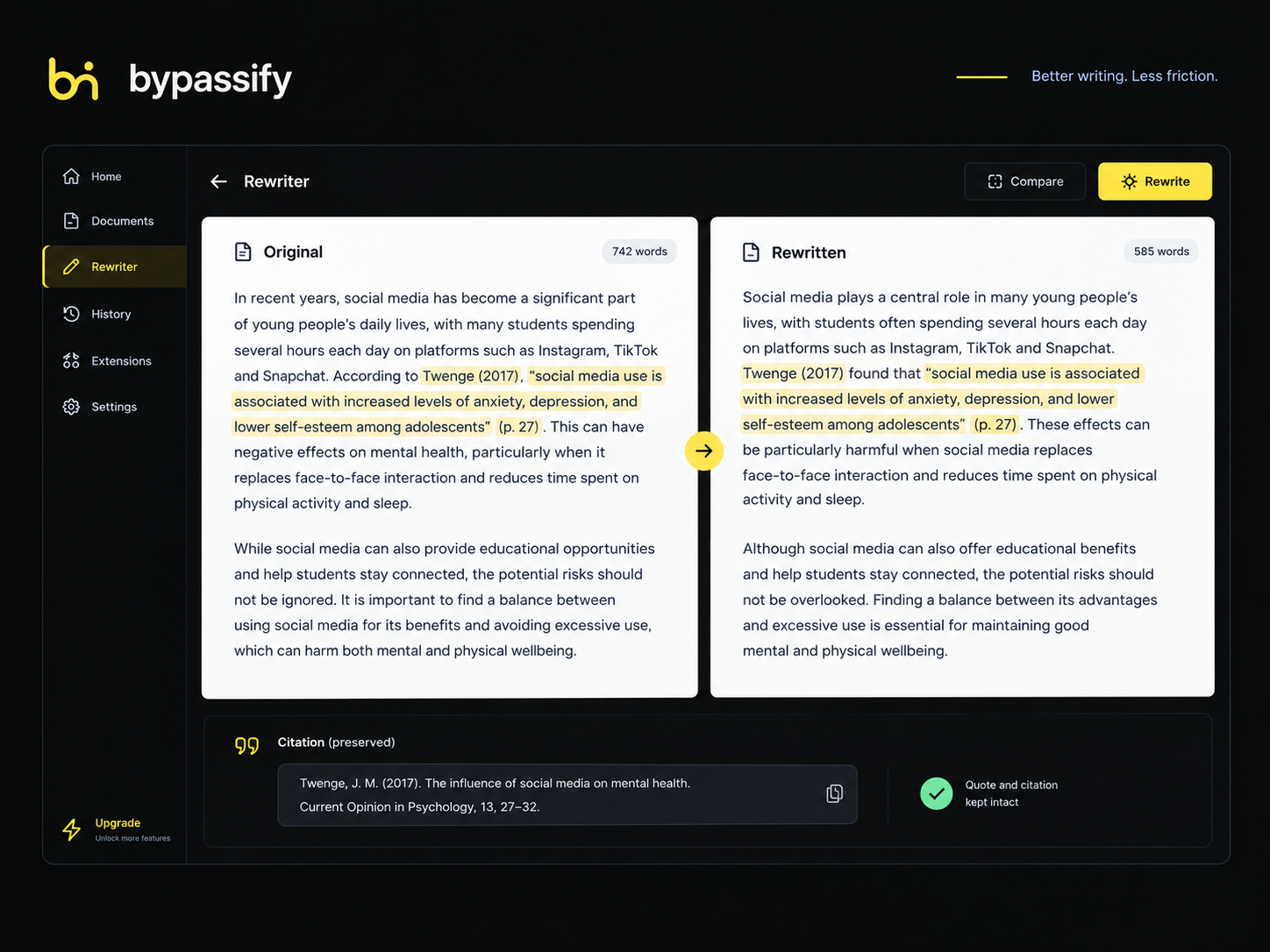
The Bypassify Rewriter improves clarity, grammar, flow, and tone while keeping your meaning, quotes, and citations exact. Use it on your own prose, then check that each citation still supports the sentence it follows.
If permitted AI-assisted drafting has left your writing stiff, the Bypassify Humanizer helps it read naturally while preserving those same elements. Neither tool verifies sources or replaces required disclosure. Do not rewrite a ChatGPT quotation and continue presenting it as verbatim output.
Before you submit
- Confirm that your AI use follows the assignment policy.
- Replace every citation placeholder with verified details.
- Match each in-text citation to its reference entry.
- Check quotations against the saved response.
- Verify factual claims in appropriate sources.
- Include any required disclosure or transcript.
Save the response you actually used
Your next step is to save the exact prompt and response behind your citation. That record gives you a reliable basis for formatting the entry, checking quotations, and explaining your use honestly.
Frequently asked questions
Do I need to cite ChatGPT if it only corrected my grammar?
Grammar-only assistance does not automatically require the same citation as quoted or paraphrased AI output, but your assignment may require disclosure. Check the course policy and describe the editing help if requested.
Is ChatGPT a personal communication in APA 7?
APA's ChatGPT guidance treats the tool as software rather than as a person providing a personal communication. Use a reference-list entry and an in-text citation when you reproduce or discuss its output.
Who is the author of ChatGPT output in MLA 9?
MLA does not recommend treating the AI tool as an author. Begin the Works Cited entry with a description of the generated material, then identify ChatGPT, the publisher, the generation date, and the location.
Can I cite sources that ChatGPT suggests?
Yes, but only after you locate and read the actual sources and confirm that they support your claim. Cite those sources directly rather than relying on ChatGPT's summary or generated bibliography.
Can I cite a private ChatGPT conversation?
Yes, although readers may not be able to inspect the conversation through a private account link. Follow the relevant style guidance, preserve a transcript, and provide an appendix or approved shared record if your assignment requires one.
Write it once. Let Bypassify keep it human.
The free browser extension humanizes or rewrites whatever you select, in any tab, using your own Writing DNA.