
Bypass GPTZero: A 2026 Guide for AI-Assisted Writing
Learn how to refine your AI-assisted drafts to sound genuinely human and pass AI detection, without changing your meaning.
Free account · 5 runs a day · No card needed
Test your own draft in the Humanizer in about 20 seconds.
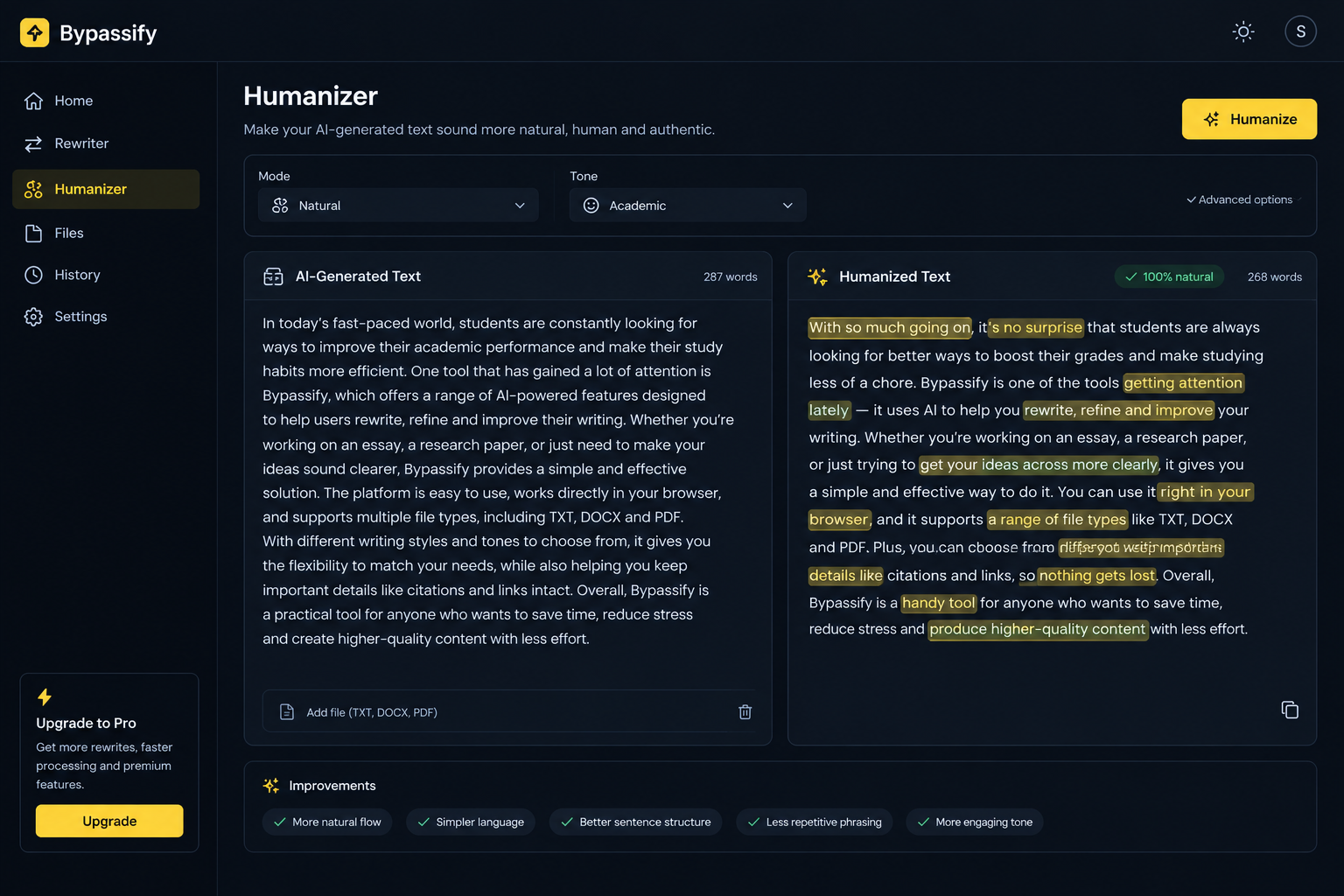
As AI writing tools become more common, so do AI detection systems like GPTZero. For students and everyday writers, navigating this landscape means understanding how to use AI responsibly and how to ensure your final work truly reflects your voice and effort. The goal is not to trick a system, but to produce writing that is clear, original, and undeniably human in its expression.
This guide explains how to refine your AI-assisted drafts so they read naturally, avoiding the generic patterns that AI detectors often flag. It is about making your writing better, not about cheating.
Understanding AI Detection Tools
AI detection tools like GPTZero analyze text for specific patterns. They look for things like:
- Predictable phrasing: AI models often choose the most statistically probable words, leading to common or formulaic sentences.
- Lack of variation: AI might use similar sentence structures or vocabulary throughout a text, reducing natural human variation.
- Overly formal or detached tone: AI can sometimes produce text that lacks personal voice, colloquialisms, or nuanced human expression.
- Repetitive ideas: Sometimes AI generates text that circles back to the same points without adding new insight.
- Unusual punctuation or grammar: While AI is good at grammar, it might occasionally use punctuation in ways that feel slightly off to a human reader.
These tools do not definitively prove AI authorship. They provide a probability score based on these patterns. Human-written text can sometimes be flagged, and AI-generated text can sometimes pass undetected, especially after careful editing. The best approach is to focus on improving your writing quality to make it sound authentically yours.
Why AI-Assisted Text Needs Humanization
Starting with an AI draft can save time, but it rarely produces a final piece of writing that is ready for submission. AI-generated text often lacks the subtle nuances, personal voice, and specific context that make human writing compelling. It can sound bland, generic, or even robotic.
Humanizing your AI-assisted drafts means:
- Injecting your unique voice: Your personality, perspective, and writing style should come through.
- Adding specific details and examples: AI often deals in generalities. You need to add the specific information that supports your points.
- Ensuring logical flow and coherence: While AI can structure paragraphs, the transitions between ideas might not always be as smooth or logical as a human writer would make them.
- Refining word choice: Replacing generic AI vocabulary with more precise, impactful, or evocative words.
- Checking for accuracy and nuance: AI can sometimes misunderstand context or present information without the necessary caveats.
Ultimately, humanizing your text is about making it your own. It is about transforming a functional draft into a piece of writing that communicates effectively and authentically.
The Humanizer Approach: Making AI Sound Natural
Bypassify's Humanizer tool is designed specifically for this task. It takes AI-generated text and reworks it to sound as though a human wrote it, while preserving your original meaning, quotes, and citations. This is not about masking AI use, but about elevating the quality of your writing.
Before and After: An Example
Let us look at a common example of AI-generated text and how the Humanizer can refine it.
AI-Generated Draft:
"The contemporary educational paradigm frequently integrates digital technologies to augment pedagogical methodologies. This incorporation facilitates personalized learning trajectories and offers learners diversified access to informational resources, thereby enhancing the overall academic experience."
This text is grammatically correct but sounds overly formal and abstract. It uses complex words where simpler ones would suffice, and the sentence structure is somewhat convoluted.
Humanized Version (via Bypassify Humanizer):
"Today, schools often use digital tools to improve how they teach. This helps create learning paths tailored to each student and gives them more ways to find information, making their educational journey better overall."
The humanized version is clearer, more direct, and easier to read. It uses simpler language and a more natural sentence structure, making the same points without sounding like a machine wrote it. This kind of transformation is what helps your work pass AI detection because it aligns with human writing patterns, not AI patterns.
To learn more about how this process works, you can visit the Bypassify Humanizer page.
The Rewriter Approach: Enhancing Clarity and Flow
Beyond humanizing, improving your writing involves refining its clarity, grammar, flow, and tone. This is where Bypassify's Rewriter comes in. Even if your initial draft was human-written, or if you have already humanized an AI draft, the Rewriter helps polish it further.
Before and After: Improving Flow
Consider a paragraph that might be technically correct but lacks smooth transitions:
Original Draft:
"The experiment failed. Data was collected anyway. The results were inconclusive. This suggests further research is needed. Funding is a concern."
This text presents facts but feels choppy and disconnected.
Rewritten Version (via Bypassify Rewriter):
"Although the experiment did not yield the expected outcomes, data was still collected. The results proved inconclusive, strongly suggesting the need for further research. However, securing adequate funding remains a significant challenge."
The rewritten version flows much better. It uses transition words and combines sentences to create a more cohesive narrative. This makes the text more engaging and easier for the reader to follow, which is a hallmark of good human writing.
For more details on how this tool can benefit your writing, see the Bypassify Rewriter page.
A Responsible Workflow for AI-Assisted Writing
Using AI tools responsibly means treating them as assistants, not as replacements for your own thinking and editing. Here is a workflow that integrates AI effectively while maintaining academic integrity and producing high-quality, human-sounding work:
- Outline and research yourself: Start with your own ideas, research, and structure. Do not let AI dictate your content from the ground up.
- Generate initial drafts (optional): If you use AI, generate only small sections or rough drafts to overcome writer's block or explore initial phrasing. Never rely on AI for your core arguments or original analysis.
- Humanize AI sections: Take any AI-generated text and run it through a tool like the Bypassify Humanizer. Focus on injecting your voice, adding specific examples, and simplifying complex phrasing.
- Review and rewrite thoroughly: Read your entire draft critically. Look for areas where the language feels generic, the flow is awkward, or the tone is inconsistent. Use Bypassify's Rewriter to refine clarity, grammar, and sentence structure.
- Fact-check and verify: Always double-check any information, quotes, or citations that appear in your draft, especially if AI was involved in generating any part of it.
- Add personal insights and conclusions: Ensure the final analysis, interpretation, and conclusions are entirely your own. This is where your unique contribution shines.
- Proofread: A final proofread for any remaining errors is always essential.
This process ensures that while you might use AI to assist with initial drafting, the final product is genuinely yours, reflecting your effort, intellect, and unique human touch. Your work should stand on its own merits, regardless of any detection tool.
Final Checklist for Human-Sounding Text
Before submitting any AI-assisted work, review it against this checklist:
- Does it sound like you? Read it aloud. Does it match your typical writing style and voice?
- Are there specific examples? Have you included concrete details, anecdotes, or evidence that only you would know or choose?
- Is the flow natural? Do sentences and paragraphs transition smoothly, or do they feel disjointed?
- Is the vocabulary varied and precise? Have you avoided repetitive word choices and used strong, specific verbs and nouns?
- Is the tone appropriate and engaging? Does it connect with your reader, or does it sound overly formal or bland?
- Are complex ideas explained clearly? Have you broken down difficult concepts without oversimplifying them?
By carefully editing your work with these points in mind, you will produce high-quality writing that is both effective and authentic.
Take the Next Step
Transform your AI-assisted drafts into polished, human-sounding documents. Start refining your writing today with Bypassify. Your unique voice deserves to be heard clearly.
Frequently asked questions
What is GPTZero?
GPTZero is one of several tools designed to identify text that has likely been generated by artificial intelligence. These tools analyze various linguistic patterns to assess the probability that a human wrote the content. They are often used in academic and professional settings to check for AI-assisted work.
Can AI detection tools reliably identify AI-generated text?
AI detection tools are not 100% accurate and can sometimes misclassify human-written text as AI-generated, or vice versa. They look for common patterns and characteristics of AI output, which can be present in human writing too. Relying solely on these tools for definitive judgment is not advisable.
Why should I make my AI-assisted writing sound more human?
Making your AI-assisted writing sound more human improves clarity, engagement, and authenticity. It helps your unique voice come through, makes your arguments more persuasive, and ensures your message connects effectively with your reader. This also reduces the likelihood of false positives from AI detection tools.
Does Bypassify change the meaning of my text?
No, Bypassify's tools, the Humanizer and the Rewriter, are designed to preserve the original meaning of your text. They focus on improving natural language, clarity, grammar, and flow while keeping all quotes, citations, and factual content exactly as you intended.
Is using Bypassify considered academic dishonesty?
Bypassify is an editing tool, not a content generator. It helps you refine your own drafts, including those you started with AI assistance, to meet high standards of clarity and human expression. This is similar to using a grammar checker or asking a tutor for feedback, which are common and accepted academic practices.
Ready to fix your own draft?
Paste a paragraph and see the result in seconds. Quotes and citations stay exactly as you wrote them, and your drafts stay private.
- 5 free runs a day
- No card needed
- Citations kept